Skip to content
NexSocials

Work FOUNDATION August 2026

Sarvashakti Energy Solutions, a fictional rooftop solar company.

Designs and builds rooftop and ground-mount solar plants for factories, from 100 kW to 10 MW. Its August 2026 on LinkedIn, planned, written and designed by NexSocials.

  • 14pieces
  • 13of 21 weekdays

What the month does

Makes the company page credible to a factory owner who checks it after a referral: every post gives him one thing he can check on a solar quote.

Written for
The founder or a director of a manufacturing company in Gujarat or Rajasthan, buying a plant of 100 kW to 10 MW.
Where
Gujarat and Rajasthan
Its themes
What's behind the number · The plant at year three · Measured, not promised · What we won't do
How often
Something goes out on 13 of August’s 21 weekdays.

Four pieces from the month, at full size.

The strongest of the 14, each with why it was made this way.

The graphic: Losing 18%. The bill never said why.

01Evidence

A plant was losing about 18% of its output, and the electricity bill could not say why.

Single image Sarvashakti Energy Solutions’s page Mon 3 Aug

Why it was made this way

For the owner who fears his plant runs under what it should, and nobody will tell him.

Source: PI Berlin for GIZ, Evaluation of Underperforming Rooftop PV Plants in India – Moving from kW to kWh, Part II, November 2022.

Sarvashakti Energy SolutionsRooftop and C&I solar EPC

A reaction time in an O&M contract is half a promise. The other half is the spare part.

A 2022 study of underperforming rooftop plants for GIZ found neither at any plant it inspected.

The inspectors, PI Berlin, visited plants across India, including in Ahmedabad, Anand and Vadodara. Their report says none had a written agreement setting reaction times, and none had spare parts on site.

…

03Point of view

The plant at year three

Text post Sarvashakti Energy Solutions’s page Tue 11 Aug

Why it was made this way

For the owner and his O&M lead, afraid that when the plant stops, nobody is bound to bring it back quickly.

Source: PI Berlin for GIZ, Evaluation of Underperforming Rooftop PV Plants in India – Moving from kW to kWh, Part II, November 2022.

The graphic: Performance ratio in the contract? We will sign it.

04Point of view

We will sign a performance ratio clause, with money attached.

Single image Sarvashakti Energy Solutions’s page Thu 27 Aug

Why it was made this way

For the finance head and the owner signing, afraid the performance figure in the proposal costs the EPC nothing if it is missed.

The whole month: all 14 pieces.

In the order they go out. Tap any piece to see it in the month on LinkedIn.

Four questions to ask before anyone writes for you.

Each answered from Sarvashakti Energy Solutions’s month, not from a promise.

  1. 1Will it sound like us?

    One voice, the company’s, kept the same for the whole month. Both come from one form of 20 questions, filled in once.

    Sarvashakti Energy Solutions’s page
    A plant was losing about 18% of its output, and the electricity bill could not say why. A week of measurement found both causes.
    See the form
  2. 2Will it be accurate?

    11 of the 14 pieces end on a Source line, naming the document behind them, so a reader can check it. One, word for word:

    Source: IPGCL, RFS No. IPGCL/RFS/RESCO/13/2025, a government rooftop tender, 25 February 2025.

    The month cites, among others

    • PI Berlin for GIZ
    • MNRE office memorandum No
    • IPGCL
    • MNRE
    • BIS
  3. 3Will it take my time?

    Your side of a month like this one: under 30 minutes. The form once, then approvals on your phone.

    1. You, onceThe form of 20 questions
    2. NexSocialsThe plan, the writing, the design, the sources
    3. You, on your phoneApprove the month’s plan, then each week’s posts
    See how a month works
  4. 4What will the posts do?

    More than announce. Of the month’s 12 planned posts:

    • 6explain how something works
    • 2show evidence: a figure, a record, a clause
    • 4give a point of view, in the voice of a person

    And two for days the country marks, outside the plan.

14 pieces, one August. Your month starts with a visibility report.

We read your page the way your buyers do, and tell you what a month like this would say for you.

Sarvashakti Energy Solutions Pvt Ltd and its people are fictional, made for this demonstration. The documents its posts cite are real, and named in their Source lines, so each one can be checked.

Preview How Sarvashakti Energy Solutions’s August 2026 appears on LinkedIn on LinkedIn

Sarvashakti Energy Solutions

Designs and builds rooftop and ground-mount solar plants for factories, from 100 kW to 10 MW.

Rooftop and C&I solar EPC

  1. Sarvashakti Energy Solutions

    Rooftop and C&I solar EPC

    3 Aug Public

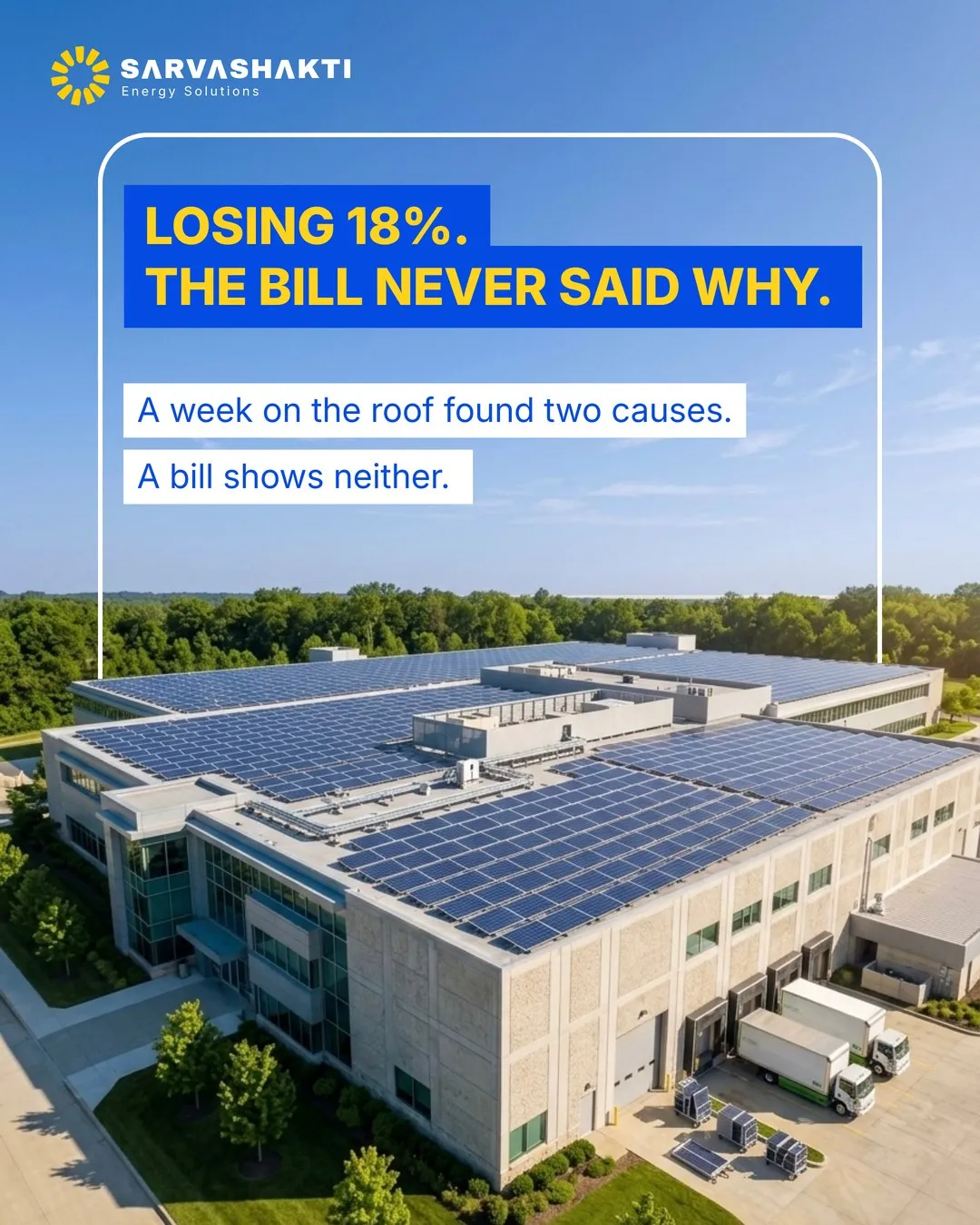
    A plant was losing about 18% of its output, and the electricity bill could not say why. A week of measurement found both causes

    A plant was losing about 18% of its output, and the electricity bill could not say why. A week of measurement found both causes. We were asked to look at a plant another company had built. The owner had one question: why had his electricity bill never come down by as much as he was promised? A bill is a slow instrument. It shows that something is wrong months after it started, and it never shows what. So we measured the plant for a week. It was producing about 18% less than that plant should produce at that site. The first cause was at the combiner box, where the strings of modules meet. Two strings were disconnected. Every module on them was producing nothing. A disconnected string usually does not trip a plant. The inverter keeps running on the strings still connected, so the plant reports as working while part of it sends nothing. The second cause was cleaning. There was no cleaning schedule. Not a poor one. None. Neither shows on a bill. A bill adds the whole plant into one number, and 18% of output is 18% of the saving, every month. It is not unique to this plant. PI Berlin's 2022 study for GIZ, of 65 rooftop plants chosen mostly for low yield, found parts of plants disconnected at a few sites, losing between 1.5% and 50%. Ask for last month's generation from your plant, against what your site should have produced. Not the bill. The plant.

    Source: PI Berlin for GIZ, Evaluation of Underperforming Rooftop PV Plants in India – Moving from kW to kWh, Part II, November 2022.

    #SarvashaktiEnergy #SolarOandM #RooftopSolarIndia

    The graphic: Losing 18%. The bill never said why.
    LikeCommentRepostSend
  2. Sarvashakti Energy Solutions

    Rooftop and C&I solar EPC

    4 Aug Public

    Three quotes for one roof can land 15 to 20% apart. Six inputs decide the number, and a quote rarely shows them

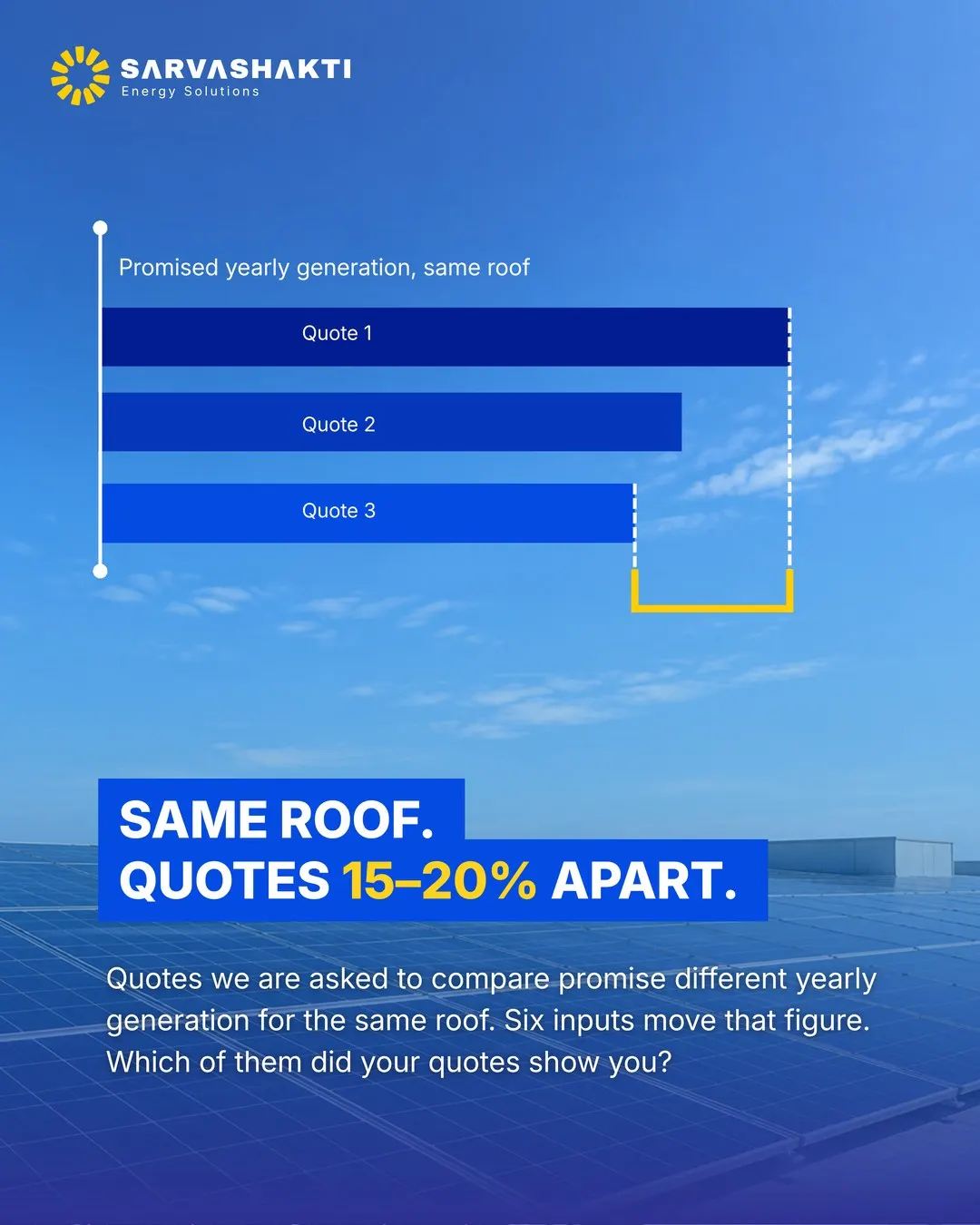
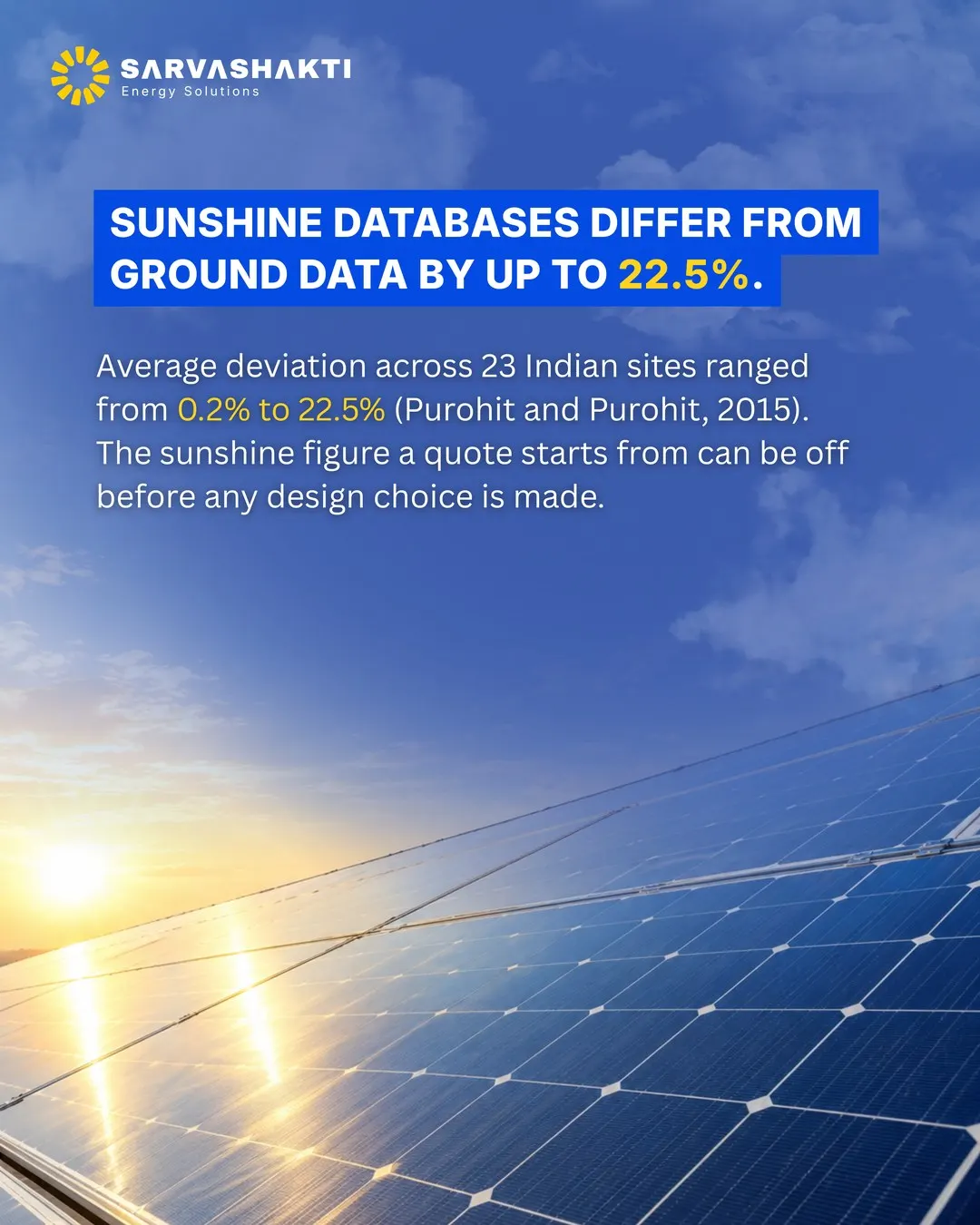
    Three quotes for one roof can land 15 to 20% apart. Six inputs decide the number, and a quote rarely shows them. That spread is what we see in the quotes factory owners bring us to compare. Three vendors, one roof, three generation figures, and no way to tell which one to trust. It rarely means anybody lied. Each figure is the end of a chain of assumptions. Change one link and the number moves. The sunshine data comes first. Against long-term ground measurement at 23 Indian sites, the average deviation of the databases ranged from 0.2% to 22.5% (Purohit and Purohit, 2015). Then the performance ratio assumed. Assume 85% instead of 80% and the yearly figure rises by about 6%, on paper, before a single module is bought. Then the losses the design accepts: output lost when the inverter hits its limit, dirt, and heat. Soiling reached 25% at some rooftop plants in a 2022 study for GIZ. Last, the loss the modules take in their first year. The module specification for subsidised household plants (PM-Surya Ghar) allows up to 3% of output in year one. Use it as a benchmark: does your quote count that loss? On a plant saving ₹1 crore a year, every 1% the number is overstated is ₹1 lakh a year you budgeted and will not see. Ask each vendor for the six inputs behind the figure, in writing. A total with nothing under it cannot be compared.

    Source: Sunshine data — Purohit and Purohit, Renewable and Sustainable Energy Reviews, vol. 50, 2015. Source: Dirt — PI Berlin for GIZ, Evaluation of Underperforming Rooftop PV Plants in India – Moving from kW to kWh, Part II, 18 November 2022. Source: Heat — (65 − 25) × 0.4% = 16%. −0.4% per °C is the weakest temperature coefficient one NHPC rooftop tender (January 2025) allows. 65°C is an example, not a measured roof. Source: First-year loss — PM-Surya Ghar guidelines, Annexure 3, cl. 1.9, which asks for output above 97% in year one.

    #SarvashaktiEnergy #SolarEPC #RooftopSolarIndia

    Six inputs behind a generation number5 pages

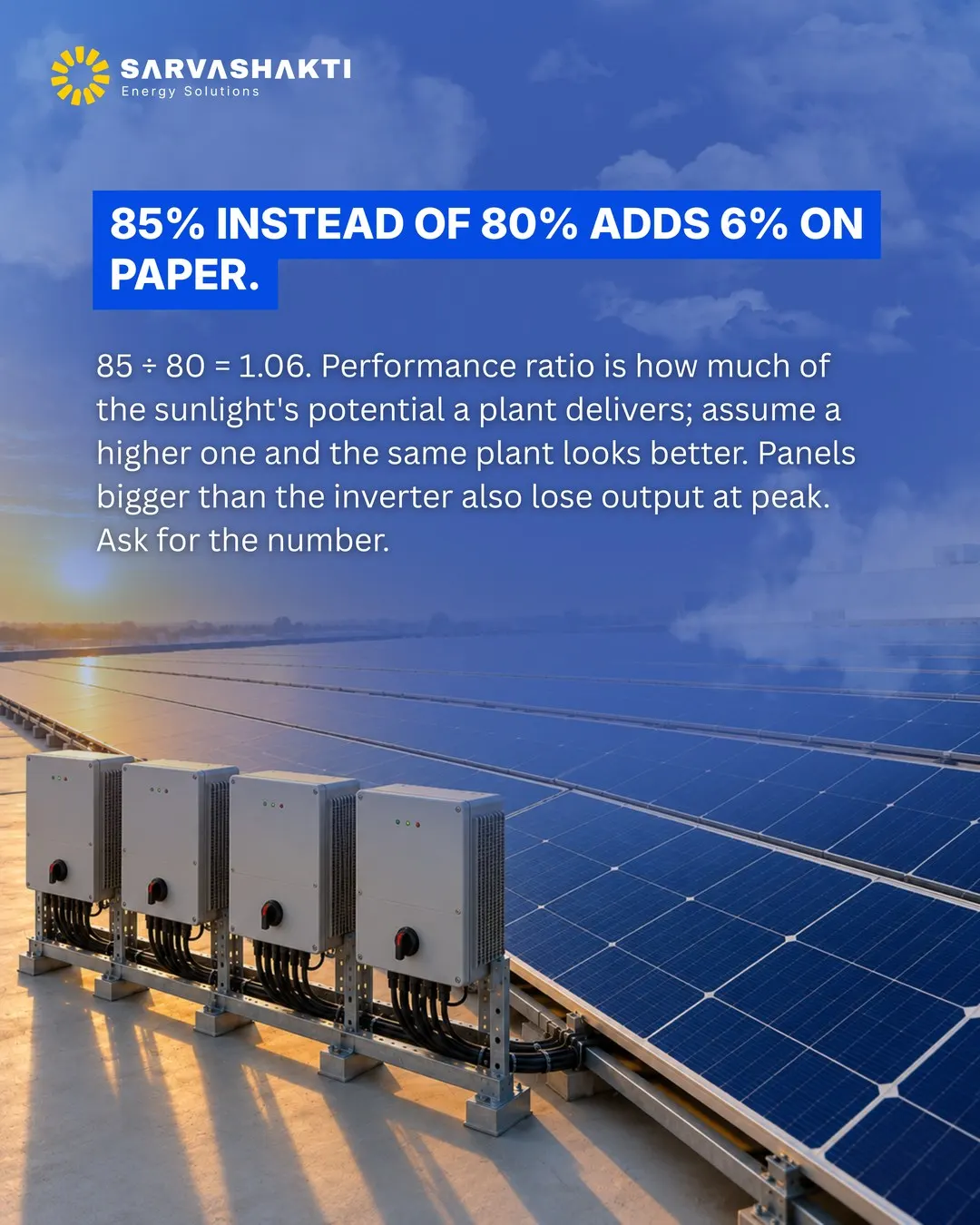
    Page 1 of 5: Same roof. Quotes 15–20% apart.Page 2 of 5: Sunshine databases differ from ground data by up to 22.5%.Page 3 of 5: 85% instead of 80% adds 6% on paper.Page 4 of 5: Dirt can take 25%, heat 16% and year one 3%.Page 5 of 5: Ask for all six, in writing.
    LikeCommentRepostSend
  3. Sarvashakti Energy Solutions

    Rooftop and C&I solar EPC

    5 Aug Public

    A generation figure sent the same evening, from roof area off Google Maps, was worked out for a roof nobody stood on. We do not quote one without a

    A generation figure sent the same evening, from roof area off Google Maps, was worked out for a roof nobody stood on. We do not quote one without a site survey. Roof area is the easy part. What we want a buyer to see is what a map cannot show: what stands near the panels. A water tank. An antenna. Trees at the boundary. A building going up next door. PI Berlin found each of these shading underperforming rooftop plants in its 2022 study for GIZ. A satellite image is one photograph, taken from directly above, on one day. Shade depends on height and on the sun's path, hour by hour and month by month. Neither shows from above. The report put the worst losses from near shading at close to 8%. It also said a proper site assessment before installation would probably have reduced them. That is up to 8% of a plant's output, every year the shade stands, missing from a figure that was compared as if it were real. If a survey finds shade, the figure goes down before the quote goes out. That is what the survey is for. A generation figure is worth exactly as much as the survey behind it. Ask each vendor who stood on your roof, and on what date. If nobody did, the figure was never about your roof. Has any vendor told you the date they stood on yours?

    Source: PI Berlin for GIZ, Evaluation of Underperforming Rooftop PV Plants in India – Moving from kW to kWh, Part II, November 2022.

    #SarvashaktiEnergy #SolarEPC #RooftopSolarIndia

    LikeCommentRepostSend
  4. Sarvashakti Energy Solutions

    Rooftop and C&I solar EPC

    6 Aug Public

    A first-year performance ratio of 82.4%, averaged across our last 40 plants. One government rooftop tender (IPGCL, 25 Feb 2025) asks the contractor to

    A first-year performance ratio of 82.4%, averaged across our last 40 plants. One government rooftop tender (IPGCL, 25 Feb 2025) asks the contractor to guarantee 75%. Performance ratio is what a plant actually delivers against what the sunlight says it could. A proposal shows a projected one. It rarely shows how the vendor's earlier plants did. Here is ours. Across our last 40 plants, the first-year performance ratio averaged 82.4%. The best plant reached 85.3%. The lowest was 78.6%. That is our own monitoring, not a certificate. Each plant has a sunlight sensor (an irradiance sensor) in the plane of its panels. The figure covers the first 12 months and is not temperature-corrected. The method matters as much as the number. Change the sensor, its angle or the period, and the same plant reports a different ratio. For comparison, a government rooftop tender (IPGCL, 25 Feb 2025) asks the contractor to guarantee 75% at commissioning. That is a test at commissioning. Ours is a year of operation. The gap is money. A plant at 82.4% produces about 10% more from the same roof and the same sunlight than one at 75%. Any vendor can put a projected ratio in a proposal. Ask to see the measured one, for plants already running, with the method written beside it. If a vendor cannot show you that record, the projection in your proposal is the only number they have.

    Source: IPGCL, RFS No. IPGCL/RFS/RESCO/13/2025, a government rooftop tender, 25 February 2025.

    #SarvashaktiEnergy #PerformanceRatio #SolarEPC

    The graphic: 82.4% in year one. One government tender asks for 75%.
    LikeCommentRepostSend
  1. Sarvashakti Energy Solutions

    Rooftop and C&I solar EPC

    10 Aug Public

    Net-metered or open access plant? Commission it after 31 December 2026 and its cells must be on ALMM List-II

    Net-metered or open access plant? Commission it after 31 December 2026 and its cells must be on ALMM List-II. ALMM List-II is the government's approved list of solar cells. List-I covers the modules; List-II covers the cells inside them. On 18 July 2026, MNRE's office memorandum No. 283/53/2026-GRID SOLAR gave net-metered and open access plants a limited window: commissioned by 31 December 2026, they are exempt from List-II. Commissioned after that, they must comply. The memorandum says plainly that this is not a blanket extension. The earlier window closed on 31 May 2026. MNRE's 4 August memo adds that the window needs no application, and that net metering here includes gross metering and net billing. Behind-the-meter plants for a private consumer's own use sit outside both lists. Nobody has to do anything wrong for the date to move. So the date is part of the specification. A plant with compliant paperwork and an honest schedule can still cross it: a late approval or a delayed delivery is enough. The memorandum states the rule; what happens to a plant that misses it is not spelled out. CareEdge Ratings estimated in December 2024 that List-II cells would add 6 to 7 US cents a watt to a domestic module, about ₹5 to 6 at the time, until local cell supply grows. A quote that assumes December commissioning and one that assumes January are not priced on the same rule, even if they look the same. Ask two things: which list the cells are on, and what the contract says happens if commissioning lands after 31 December.

    Source: MNRE office memorandum No. 283/53/2026-GRID SOLAR, 18 July 2026, para 3. Source: MNRE office memorandum No. 283/54/2026-GRID SOLAR, 4 August 2026, paras 1(b) and 1(e)(i). Source: CareEdge Ratings, December 2024, estimate of the added cost of ALMM List-II cells.

    #SarvashaktiEnergy #ALMM #SolarEPC

    The date that decides which cells you may use4 pages

    Page 1 of 4: Net-metered or open access plant? 31 December decides your cells.Page 2 of 4: List-II cells may add 6–7 US cents a watt.Page 3 of 4: Nobody has to do anything wrong.Page 4 of 4: Ask your vendor 2 questions.
    LikeCommentRepostSend
  2. Sarvashakti Energy Solutions

    Rooftop and C&I solar EPC

    11 Aug Public

    A reaction time in an O&M contract is half a promise. The other half is the spare part

    A reaction time in an O&M contract is half a promise. The other half is the spare part. A 2022 study of underperforming rooftop plants for GIZ found neither at any plant it inspected. The inspectors, PI Berlin, visited plants across India, including in Ahmedabad, Anand and Vadodara. Their report says none had a written agreement setting reaction times, and none had spare parts on site. The two gaps are one gap. A technician who arrives on time without the part has arrived to write down what is broken. That is why the report treats them together. Its advice ends with stronger O&M contracts: shorter reaction times, and the spare parts stored to keep them. What waiting costs depends on what failed. At one plant in the study, a malfunctioning inverter took out an entire section of the system, roughly 50% of its output. The report also names the absence of O&M contracts with clear procedures as a key factor in lowering a plant's output. Our maintenance team is our own, not a subcontractor, and the engineer who designed the plant is on the call when something goes wrong. In our experience, the person who chose the string layout is the fastest one to find what has gone wrong with it. Read the O&M clause for two things together: the reaction time, and which spare parts are kept, and where. Either one alone leaves a stopped plant waiting. Does your contract name both?

    Source: PI Berlin for GIZ, Evaluation of Underperforming Rooftop PV Plants in India – Moving from kW to kWh, Part II, November 2022.

    #SarvashaktiEnergy #SolarOandM
    LikeCommentRepostSend
  3. Sarvashakti Energy Solutions

    Rooftop and C&I solar EPC

    12 Aug Public

    A performance guarantee is a percentage and a way of measuring it. The percentage gets read; the method decides whether the plant passes

    A performance guarantee is a percentage and a way of measuring it. The percentage gets read; the method decides whether the plant passes. A government rooftop tender (IPGCL, 25 Feb 2025) runs a performance guarantee test at commissioning. It compares the plant's measured performance ratio against a guaranteed 75%. Performance ratio is the plant's actual output against what the sunlight that day says it should have produced. So the result depends on how the sunlight was measured. Which irradiance sensor was used. Where it was mounted, and at what angle. How many days the test ran. Whether module temperature was corrected for. Change any of those and the same plant can report a different percentage. There is an international standard for this. IEC 61724-1, published in July 2021, sets out the terminology, equipment and methods for monitoring a plant's performance, including requirements for irradiance sensors. Each point matters. One point of performance ratio is about 1/80th of a plant's output at 80% — roughly ₹1.25 lakh a year on a plant saving ₹1 crore, every year of its life. A guarantee that names the percentage but not the method leaves the measurement to whoever runs the test. Read the measurement clause, not the percentage: which sensor, mounted where, over how many days.

    Source: IPGCL, RFS No. IPGCL/RFS/RESCO/13/2025, a government rooftop tender, 25 February 2025. Source: IEC 61724-1:2021, Photovoltaic system performance — Part 1: Monitoring, July 2021.

    #SarvashaktiEnergy #PerformanceRatio #SolarEPC

    The graphic: One tender guarantees 75%. Measured how?
    LikeCommentRepostSend
  4. Sarvashakti Energy Solutions

    Rooftop and C&I solar EPC

    15 Aug Public

    Wishing everyone a happy 80th Independence Day. On this day in 1947, India began to govern itself. The day belongs to everyone who has built

    Wishing everyone a happy 80th Independence Day. On this day in 1947, India began to govern itself. The day belongs to everyone who has built something here since: in fields, in workshops, in factories. This morning, on factory roofs across Gujarat and Rajasthan, the sun is already making part of the day's power right where it is used. Jai Hind.

    #SarvashaktiEnergy #IndependenceDay

    The graphic: Happy Independence Day
    LikeCommentRepostSend
  1. Sarvashakti Energy Solutions

    Rooftop and C&I solar EPC

    17 Aug Public

    Until 31 December, a maker can sell a solar inverter above 200 kW on its own declaration that it complies. But only if it holds two documents. Ask for

    Until 31 December, a maker can sell a solar inverter above 200 kW on its own declaration that it complies. But only if it holds two documents. Ask for both, for the exact model, before you order. MNRE's notification of 3 July 2026 (Gazette of India, 8 July) extended self-certification for these inverters to 31 December 2026, or until further orders. The earlier deadline was 30 June 2026. The extension has a condition. The maker must hold valid IEC certificates for the Indian standards the order names, and test reports from accredited labs. That turns a vague assurance into two documents a buyer can ask for: the IEC certificate and the accredited lab's test report. Ask for them for the exact inverter model in your quote, not for the maker's range. A maker who meets the condition already has them. Then look at the date. After 31 December, unless MNRE extends again, a maker's own declaration is no longer enough: these inverters need BIS certification. A plant commissioned in 2027 on an inverter with only a self-declaration has no BIS certificate to show. Two documents, for one model, before the order is placed. Has your vendor shown you both?

    Source: MNRE notification S.O. 3706(E), Gazette of India, 8 July 2026, under the Solar Systems, Devices and Components Goods Order, 2025.

    #SarvashaktiEnergy #SolarInverters #SolarEPC

    LikeCommentRepostSend
  2. Sarvashakti Energy Solutions

    Rooftop and C&I solar EPC

    18 Aug Public

    A subsidised home's rooftop plant is checked against a detailed specification before the subsidy is paid. A factory's plant is held to its contract

    A subsidised home's rooftop plant is checked against a detailed specification before the subsidy is paid. A factory's plant is held to its contract, plus the few rules that reach it. Under MNRE's household scheme, the DISCOM inspects each plant against the scheme's technical specification before the subsidy is released. Your factory is not in that scheme. Some rules still reach a factory plant. MNRE's 4 August memo says List-I compliance still applies to net-metered and open access plants. But a list is not a specification. The specification is the detail: a fill factor of at least 75%, which is how well a module turns light into power. A temperature coefficient no worse than −0.4% per °C, which is how much power a module loses as it heats. And more than 97% of rated output in the first year. A factory contract that names none of these leaves all three open. A lender's technical adviser may check a plant against a specification. A 2017 pilot study for PTB found such advisers not yet fully established in India's solar sector. In a 2022 study for GIZ of 65 rooftop plants, chosen mostly for low yield, modules performed below their expected output at nearly every plant, and system losses could exceed 15%. If the module that arrives is weaker on any of these, there is no clause to hold anyone to. Write the lines into the contract as an annexure: fill factor at least 75%, temperature coefficient no worse than −0.4% per °C, and the first-year cap in MNRE's Annexure 3, cl. 1.9.

    Source: MNRE, PM-Surya Ghar guidelines, Annexure 3, cl. 1.6, 1.8 and 1.9, July 2024. Source: MNRE office memorandum No. 283/54/2026-GRID SOLAR, 4 August 2026, para 1(b). Source: PI Berlin for PTB, Pilot Study on Quality Aspects of PV Power Plants in India, 2017. Source: PI Berlin for GIZ, Evaluation of Underperforming Rooftop PV Plants in India – Moving from kW to kWh, Part II, November 2022.

    #SarvashaktiEnergy #SolarEPC #RooftopSolarIndia

    The graphic: Subsidised homes get a spec check. Factories get their contract.
    LikeCommentRepostSend
  3. Sarvashakti Energy Solutions

    Rooftop and C&I solar EPC

    19 Aug Public

    Every rooftop solar plant needs a clear pathway at least 75 cm wide, with hand rails, for roof access and emergency exit. It comes out of the roof

    Every rooftop solar plant needs a clear pathway at least 75 cm wide, with hand rails, for roof access and emergency exit. It comes out of the roof your quote is filling. The rule is Regulation 121 of the Central Electricity Authority's safety regulations, notified on 8 June 2023. It sets the safety requirements for solar installations. Its first line is about rooftop systems. It asks for "clear pathways of minimum seventy five centimetre in width with hand rails for roof access and emergency exit". Its second line asks for clear walkways between the rows or columns of panels, for cleaning and maintenance. Both take roof. A layout that runs panels edge to edge, or packs the rows tight, has drawn a plant the regulation does not allow. Either the layout changes after the quote, or the capacity does. Regulation 121 goes beyond layout. Every combiner box needs a surge protective device with arc extinguishing capability, "to avoid any risk of fire". Earth strips must be welded, not bolted. And a fire detection system and automatic fire suppression system "shall comply with the relevant standards". None of these lines shows on a quote that gives only a kWp figure and a price per watt. Ask whether the kWp in your quote already allows for the 75 cm pathway and the walkways, and where the hand rails and the fire system sit in the bill of materials.

    Source: Central Electricity Authority (Measures relating to Safety and Electric Supply) Regulations, 2023, Gazette of India, 8 June 2023, Regulation 121(1)(i) and (ii), 121(2)(iv), 121(3)(ii) and 121(4).

    #SarvashaktiEnergy #RooftopSolarIndia #SolarEPC

    The graphic: Every rooftop plant needs a 75 cm pathway.
    LikeCommentRepostSend
  4. Sarvashakti Energy Solutions

    Rooftop and C&I solar EPC

    20 Aug Public

    Happy Akshay Urja Diwas. Today is India's renewable energy day, a day to mark how far renewable power in India has come

    Happy Akshay Urja Diwas. Today is India's renewable energy day, a day to mark how far renewable power in India has come. By 31 July 2026, India's installed solar capacity had reached 164.59 GW (PIB, 13 August 2026). It was 2.8 GW in 2014. That was built by engineers, installers, manufacturers, and owners who chose to build their own. We are glad to be a small part of it, on factory roofs in Gujarat and Rajasthan.

    #SarvashaktiEnergy #AkshayUrjaDiwas

    The graphic: Happy Akshay Urja Diwas
    LikeCommentRepostSend
  1. Sarvashakti Energy Solutions

    Rooftop and C&I solar EPC

    24 Aug Public

    On the day the modules arrive, check three things before anyone lifts one onto the roof. First, that the module is the model named in your quote

    On the day the modules arrive, check three things before anyone lifts one onto the roof. First, that the module is the model named in your quote. Swapping a cheaper one in at delivery happens; we have lost work to vendors who do it. Second, that the model is on ALMM List-I. MNRE's 4 August memo says List-I still applies to net-metered and open access plants. Revision L of the list is dated 3 August 2026. Third, that its BIS registration is valid. Every listing in Revision L is "subject to valid BIS Registration; else deemed to be delisted". BIS's own CARE app checks the eight-digit R-number printed with the BIS mark. Fail any one and the plant is built on modules it was not sold, or that its connection's rules do not allow. Three checks, one afternoon, before the modules go up.

    Source: MNRE, Approved List of Models and Manufacturers (ALMM) List-I, Revision L, 3 August 2026. Source: MNRE office memorandum No. 283/54/2026-GRID SOLAR, 4 August 2026, para 1(b). Source: BIS, "BIS CARE App", BIS blog, 18 November 2021.

    #SarvashaktiEnergy #ALMM #SolarModules

    The graphic: Three checks before the modules go up.
    LikeCommentRepostSend
  2. Sarvashakti Energy Solutions

    Rooftop and C&I solar EPC

    27 Aug Public

    We will sign a performance ratio clause, with money attached. Every solar proposal carries a performance figure. What matters is where that figure

    We will sign a performance ratio clause, with money attached. Every solar proposal carries a performance figure. What matters is where that figure sits. If it sits only in the proposal, it is a promise. If the plant falls short, the EPC pays nothing. If it sits in the agreement, with money attached, it is a commitment. If the plant falls short, the EPC pays. We can sign because we measure. Across our last 40 plants, the first-year performance ratio averaged 82.4%. The best reached 85.3%, the lowest 78.6%. That is our own monitoring, not a certificate: a sunlight sensor in the plane of the panels, over the first 12 months, not temperature-corrected. How it works. You send us the quote request you are about to issue. We survey the roof. Then we agree the figure and the way it is measured, plant by plant, and write both into the agreement. We have built 185 MW across more than 140 plants since 2014. Send us your quote request, here or with the Contact us button on this page.

    #SarvashaktiEnergy #SolarEPC #PerformanceRatio

    The graphic: Performance ratio in the contract? We will sign it.
    LikeCommentRepostSend

August 2026 ends here: 14 posts on Sarvashakti Energy Solutions’s page.

1 of 14

Why it was made this wayFor the owner who fears his plant runs under what it should, and nobody will tell him.

Evidence · The plant at year three

Sarvashakti Energy Solutions

Rooftop and C&I solar EPC

Mon 3 Aug public, Single image

A plant was losing about 18% of its output, and the electricity bill could not say why. A week of measurement found both causes.

We were asked to look at a plant another company had built. The owner had one question: why had his electricity bill never come down by as much as he was promised? A bill is a slow instrument. It shows that something is wrong months after it started, and it never shows what. So we measured the plant for a week. It was producing about 18% less than that plant should produce at that site. The first cause was at the combiner box, where the strings of modules meet. Two strings were disconnected. Every module on them was producing nothing. A disconnected string usually does not trip a plant. The inverter keeps running on the strings still connected, so the plant reports as working while part of it sends nothing. The second cause was cleaning. There was no cleaning schedule. Not a poor one. None. Neither shows on a bill. A bill adds the whole plant into one number, and 18% of output is 18% of the saving, every month. It is not unique to this plant. PI Berlin's 2022 study for GIZ, of 65 rooftop plants chosen mostly for low yield, found parts of plants disconnected at a few sites, losing between 1.5% and 50%. Ask for last month's generation from your plant, against what your site should have produced. Not the bill. The plant.

Source: PI Berlin for GIZ, Evaluation of Underperforming Rooftop PV Plants in India – Moving from kW to kWh, Part II, November 2022.

#SarvashaktiEnergy #SolarOandM #RooftopSolarIndia
The graphic: Losing 18%. The bill never said why.
LikeCommentRepostSend

2 of 14

Why it was made this wayFor the owner holding three quotes he cannot tell apart, afraid of signing the wrong one.

Explains · What's behind the number

Sarvashakti Energy Solutions

Rooftop and C&I solar EPC

Tue 4 Aug public, Carousel, 5 pages

Three quotes for one roof can land 15 to 20% apart. Six inputs decide the number, and a quote rarely shows them.

That spread is what we see in the quotes factory owners bring us to compare. Three vendors, one roof, three generation figures, and no way to tell which one to trust. It rarely means anybody lied. Each figure is the end of a chain of assumptions. Change one link and the number moves. The sunshine data comes first. Against long-term ground measurement at 23 Indian sites, the average deviation of the databases ranged from 0.2% to 22.5% (Purohit and Purohit, 2015). Then the performance ratio assumed. Assume 85% instead of 80% and the yearly figure rises by about 6%, on paper, before a single module is bought. Then the losses the design accepts: output lost when the inverter hits its limit, dirt, and heat. Soiling reached 25% at some rooftop plants in a 2022 study for GIZ. Last, the loss the modules take in their first year. The module specification for subsidised household plants (PM-Surya Ghar) allows up to 3% of output in year one. Use it as a benchmark: does your quote count that loss? On a plant saving ₹1 crore a year, every 1% the number is overstated is ₹1 lakh a year you budgeted and will not see. Ask each vendor for the six inputs behind the figure, in writing. A total with nothing under it cannot be compared.

Source: Sunshine data — Purohit and Purohit, Renewable and Sustainable Energy Reviews, vol. 50, 2015. Source: Dirt — PI Berlin for GIZ, Evaluation of Underperforming Rooftop PV Plants in India – Moving from kW to kWh, Part II, 18 November 2022. Source: Heat — (65 − 25) × 0.4% = 16%. −0.4% per °C is the weakest temperature coefficient one NHPC rooftop tender (January 2025) allows. 65°C is an example, not a measured roof. Source: First-year loss — PM-Surya Ghar guidelines, Annexure 3, cl. 1.9, which asks for output above 97% in year one.

#SarvashaktiEnergy #SolarEPC #RooftopSolarIndia

Six inputs behind a generation number5 pages

Page 1: Same roof. Quotes 15–20% apart.Page 2: Sunshine databases differ from ground data by up to 22.5%.Page 3: 85% instead of 80% adds 6% on paper.Page 4: Dirt can take 25%, heat 16% and year one 3%.Page 5: Ask for all six, in writing.
LikeCommentRepostSend

3 of 14

Why it was made this wayFor the owner comparing vendors' figures, afraid none of them was checked on his own roof.

Point of view · What's behind the number

Sarvashakti Energy Solutions

Rooftop and C&I solar EPC

Wed 5 Aug public, Text post

A generation figure sent the same evening, from roof area off Google Maps, was worked out for a roof nobody stood on. We do not quote one without a site survey. Roof area is the easy part. What we want a buyer to see is what a map cannot show: what stands near the panels. A water tank. An antenna. Trees at the boundary. A building going up next door. PI Berlin found each of these shading underperforming rooftop plants in its 2022 study for GIZ. A satellite image is one photograph, taken from directly above, on one day. Shade depends on height and on the sun's path, hour by hour and month by month. Neither shows from above. The report put the worst losses from near shading at close to 8%. It also said a proper site assessment before installation would probably have reduced them. That is up to 8% of a plant's output, every year the shade stands, missing from a figure that was compared as if it were real. If a survey finds shade, the figure goes down before the quote goes out. That is what the survey is for. A generation figure is worth exactly as much as the survey behind it. Ask each vendor who stood on your roof, and on what date. If nobody did, the figure was never about your roof. Has any vendor told you the date they stood on yours?

Source: PI Berlin for GIZ, Evaluation of Underperforming Rooftop PV Plants in India – Moving from kW to kWh, Part II, November 2022.

#SarvashaktiEnergy #SolarEPC #RooftopSolarIndia

LikeCommentRepostSend

4 of 14

Why it was made this wayFor the owner who suspects the number in a proposal is decoration.

Evidence · Measured, not promised

Sarvashakti Energy Solutions

Rooftop and C&I solar EPC

Thu 6 Aug public, Single image

A first-year performance ratio of 82.4%, averaged across our last 40 plants. One government rooftop tender (IPGCL, 25 Feb 2025) asks the contractor to guarantee 75%.

Performance ratio is what a plant actually delivers against what the sunlight says it could. A proposal shows a projected one. It rarely shows how the vendor's earlier plants did. Here is ours. Across our last 40 plants, the first-year performance ratio averaged 82.4%. The best plant reached 85.3%. The lowest was 78.6%. That is our own monitoring, not a certificate. Each plant has a sunlight sensor (an irradiance sensor) in the plane of its panels. The figure covers the first 12 months and is not temperature-corrected. The method matters as much as the number. Change the sensor, its angle or the period, and the same plant reports a different ratio. For comparison, a government rooftop tender (IPGCL, 25 Feb 2025) asks the contractor to guarantee 75% at commissioning. That is a test at commissioning. Ours is a year of operation. The gap is money. A plant at 82.4% produces about 10% more from the same roof and the same sunlight than one at 75%. Any vendor can put a projected ratio in a proposal. Ask to see the measured one, for plants already running, with the method written beside it. If a vendor cannot show you that record, the projection in your proposal is the only number they have.

Source: IPGCL, RFS No. IPGCL/RFS/RESCO/13/2025, a government rooftop tender, 25 February 2025.

#SarvashaktiEnergy #PerformanceRatio #SolarEPC

The graphic: 82.4% in year one. One government tender asks for 75%.
LikeCommentRepostSend

5 of 14

Why it was made this wayFor the owner and his finance head, afraid a slipped commissioning date turns a compliant order into a non-compliant one.

Explains · What's behind the number

Sarvashakti Energy Solutions

Rooftop and C&I solar EPC

Mon 10 Aug public, Carousel, 4 pages

Net-metered or open access plant? Commission it after 31 December 2026 and its cells must be on ALMM List-II.

ALMM List-II is the government's approved list of solar cells. List-I covers the modules; List-II covers the cells inside them. On 18 July 2026, MNRE's office memorandum No. 283/53/2026-GRID SOLAR gave net-metered and open access plants a limited window: commissioned by 31 December 2026, they are exempt from List-II. Commissioned after that, they must comply. The memorandum says plainly that this is not a blanket extension. The earlier window closed on 31 May 2026. MNRE's 4 August memo adds that the window needs no application, and that net metering here includes gross metering and net billing. Behind-the-meter plants for a private consumer's own use sit outside both lists. Nobody has to do anything wrong for the date to move. So the date is part of the specification. A plant with compliant paperwork and an honest schedule can still cross it: a late approval or a delayed delivery is enough. The memorandum states the rule; what happens to a plant that misses it is not spelled out. CareEdge Ratings estimated in December 2024 that List-II cells would add 6 to 7 US cents a watt to a domestic module, about ₹5 to 6 at the time, until local cell supply grows. A quote that assumes December commissioning and one that assumes January are not priced on the same rule, even if they look the same. Ask two things: which list the cells are on, and what the contract says happens if commissioning lands after 31 December.

Source: MNRE office memorandum No. 283/53/2026-GRID SOLAR, 18 July 2026, para 3. Source: MNRE office memorandum No. 283/54/2026-GRID SOLAR, 4 August 2026, paras 1(b) and 1(e)(i). Source: CareEdge Ratings, December 2024, estimate of the added cost of ALMM List-II cells.

#SarvashaktiEnergy #ALMM #SolarEPC

The date that decides which cells you may use4 pages

Page 1: Net-metered or open access plant? 31 December decides your cells.Page 2: List-II cells may add 6–7 US cents a watt.Page 3: Nobody has to do anything wrong.Page 4: Ask your vendor 2 questions.
LikeCommentRepostSend

6 of 14

Why it was made this wayFor the owner and his O&M lead, afraid that when the plant stops, nobody is bound to bring it back quickly.

Point of view · The plant at year three

Sarvashakti Energy Solutions

Rooftop and C&I solar EPC

Tue 11 Aug public, Text post

A reaction time in an O&M contract is half a promise. The other half is the spare part. A 2022 study of underperforming rooftop plants for GIZ found neither at any plant it inspected. The inspectors, PI Berlin, visited plants across India, including in Ahmedabad, Anand and Vadodara. Their report says none had a written agreement setting reaction times, and none had spare parts on site. The two gaps are one gap. A technician who arrives on time without the part has arrived to write down what is broken. That is why the report treats them together. Its advice ends with stronger O&M contracts: shorter reaction times, and the spare parts stored to keep them. What waiting costs depends on what failed. At one plant in the study, a malfunctioning inverter took out an entire section of the system, roughly 50% of its output. The report also names the absence of O&M contracts with clear procedures as a key factor in lowering a plant's output. Our maintenance team is our own, not a subcontractor, and the engineer who designed the plant is on the call when something goes wrong. In our experience, the person who chose the string layout is the fastest one to find what has gone wrong with it. Read the O&M clause for two things together: the reaction time, and which spare parts are kept, and where. Either one alone leaves a stopped plant waiting. Does your contract name both?

Source: PI Berlin for GIZ, Evaluation of Underperforming Rooftop PV Plants in India – Moving from kW to kWh, Part II, November 2022.

#SarvashaktiEnergy #SolarOandM
LikeCommentRepostSend

7 of 14

Why it was made this wayFor the technical lead and the finance head relying on a guarantee, afraid it can be argued away when it is tested.

Explains · Measured, not promised

Sarvashakti Energy Solutions

Rooftop and C&I solar EPC

Wed 12 Aug public, Single image

A performance guarantee is a percentage and a way of measuring it. The percentage gets read; the method decides whether the plant passes.

A government rooftop tender (IPGCL, 25 Feb 2025) runs a performance guarantee test at commissioning. It compares the plant's measured performance ratio against a guaranteed 75%. Performance ratio is the plant's actual output against what the sunlight that day says it should have produced. So the result depends on how the sunlight was measured. Which irradiance sensor was used. Where it was mounted, and at what angle. How many days the test ran. Whether module temperature was corrected for. Change any of those and the same plant can report a different percentage. There is an international standard for this. IEC 61724-1, published in July 2021, sets out the terminology, equipment and methods for monitoring a plant's performance, including requirements for irradiance sensors. Each point matters. One point of performance ratio is about 1/80th of a plant's output at 80% — roughly ₹1.25 lakh a year on a plant saving ₹1 crore, every year of its life. A guarantee that names the percentage but not the method leaves the measurement to whoever runs the test. Read the measurement clause, not the percentage: which sensor, mounted where, over how many days.

Source: IPGCL, RFS No. IPGCL/RFS/RESCO/13/2025, a government rooftop tender, 25 February 2025. Source: IEC 61724-1:2021, Photovoltaic system performance — Part 1: Monitoring, July 2021.

#SarvashaktiEnergy #PerformanceRatio #SolarEPC

The graphic: One tender guarantees 75%. Measured how?
LikeCommentRepostSend

8 of 14

Why it was made this wayFor everyone who follows the page, on the 80th Independence Day.

Occasion

Sarvashakti Energy Solutions

Rooftop and C&I solar EPC

Sat 15 Aug public, Single image

Wishing everyone a happy 80th Independence Day.

On this day in 1947, India began to govern itself. The day belongs to everyone who has built something here since: in fields, in workshops, in factories. This morning, on factory roofs across Gujarat and Rajasthan, the sun is already making part of the day's power right where it is used. Jai Hind.

#SarvashaktiEnergy #IndependenceDay

The graphic: Happy Independence Day
LikeCommentRepostSend

9 of 14

Why it was made this wayFor the procurement head and the O&M lead, afraid the inverter in the quote has nothing behind it but the maker's word.

Explains · What we won't do

Sarvashakti Energy Solutions

Rooftop and C&I solar EPC

Mon 17 Aug public, Text post

Until 31 December, a maker can sell a solar inverter above 200 kW on its own declaration that it complies. But only if it holds two documents. Ask for both, for the exact model, before you order. MNRE's notification of 3 July 2026 (Gazette of India, 8 July) extended self-certification for these inverters to 31 December 2026, or until further orders. The earlier deadline was 30 June 2026. The extension has a condition. The maker must hold valid IEC certificates for the Indian standards the order names, and test reports from accredited labs. That turns a vague assurance into two documents a buyer can ask for: the IEC certificate and the accredited lab's test report. Ask for them for the exact inverter model in your quote, not for the maker's range. A maker who meets the condition already has them. Then look at the date. After 31 December, unless MNRE extends again, a maker's own declaration is no longer enough: these inverters need BIS certification. A plant commissioned in 2027 on an inverter with only a self-declaration has no BIS certificate to show. Two documents, for one model, before the order is placed. Has your vendor shown you both?

Source: MNRE notification S.O. 3706(E), Gazette of India, 8 July 2026, under the Solar Systems, Devices and Components Goods Order, 2025.

#SarvashaktiEnergy #SolarInverters #SolarEPC

LikeCommentRepostSend

10 of 14

Why it was made this wayFor the owner and the procurement head at a private factory, afraid nobody checks what he is being sold.

Explains · What's behind the number

Sarvashakti Energy Solutions

Rooftop and C&I solar EPC

Tue 18 Aug public, Single image

A subsidised home's rooftop plant is checked against a detailed specification before the subsidy is paid. A factory's plant is held to its contract, plus the few rules that reach it.

Under MNRE's household scheme, the DISCOM inspects each plant against the scheme's technical specification before the subsidy is released. Your factory is not in that scheme. Some rules still reach a factory plant. MNRE's 4 August memo says List-I compliance still applies to net-metered and open access plants. But a list is not a specification. The specification is the detail: a fill factor of at least 75%, which is how well a module turns light into power. A temperature coefficient no worse than −0.4% per °C, which is how much power a module loses as it heats. And more than 97% of rated output in the first year. A factory contract that names none of these leaves all three open. A lender's technical adviser may check a plant against a specification. A 2017 pilot study for PTB found such advisers not yet fully established in India's solar sector. In a 2022 study for GIZ of 65 rooftop plants, chosen mostly for low yield, modules performed below their expected output at nearly every plant, and system losses could exceed 15%. If the module that arrives is weaker on any of these, there is no clause to hold anyone to. Write the lines into the contract as an annexure: fill factor at least 75%, temperature coefficient no worse than −0.4% per °C, and the first-year cap in MNRE's Annexure 3, cl. 1.9.

Source: MNRE, PM-Surya Ghar guidelines, Annexure 3, cl. 1.6, 1.8 and 1.9, July 2024. Source: MNRE office memorandum No. 283/54/2026-GRID SOLAR, 4 August 2026, para 1(b). Source: PI Berlin for PTB, Pilot Study on Quality Aspects of PV Power Plants in India, 2017. Source: PI Berlin for GIZ, Evaluation of Underperforming Rooftop PV Plants in India – Moving from kW to kWh, Part II, November 2022.

#SarvashaktiEnergy #SolarEPC #RooftopSolarIndia

The graphic: Subsidised homes get a spec check. Factories get their contract.
LikeCommentRepostSend

11 of 14

Why it was made this wayFor the owner and the engineer signing off the layout, afraid the quoted capacity will not fit once the safety rules apply.

Explains · What's behind the number

Sarvashakti Energy Solutions

Rooftop and C&I solar EPC

Wed 19 Aug public, Single image

Every rooftop solar plant needs a clear pathway at least 75 cm wide, with hand rails, for roof access and emergency exit. It comes out of the roof your quote is filling.

The rule is Regulation 121 of the Central Electricity Authority's safety regulations, notified on 8 June 2023. It sets the safety requirements for solar installations. Its first line is about rooftop systems. It asks for "clear pathways of minimum seventy five centimetre in width with hand rails for roof access and emergency exit". Its second line asks for clear walkways between the rows or columns of panels, for cleaning and maintenance. Both take roof. A layout that runs panels edge to edge, or packs the rows tight, has drawn a plant the regulation does not allow. Either the layout changes after the quote, or the capacity does. Regulation 121 goes beyond layout. Every combiner box needs a surge protective device with arc extinguishing capability, "to avoid any risk of fire". Earth strips must be welded, not bolted. And a fire detection system and automatic fire suppression system "shall comply with the relevant standards". None of these lines shows on a quote that gives only a kWp figure and a price per watt. Ask whether the kWp in your quote already allows for the 75 cm pathway and the walkways, and where the hand rails and the fire system sit in the bill of materials.

Source: Central Electricity Authority (Measures relating to Safety and Electric Supply) Regulations, 2023, Gazette of India, 8 June 2023, Regulation 121(1)(i) and (ii), 121(2)(iv), 121(3)(ii) and 121(4).

#SarvashaktiEnergy #RooftopSolarIndia #SolarEPC

The graphic: Every rooftop plant needs a 75 cm pathway.
LikeCommentRepostSend

12 of 14

Why it was made this wayFor everyone who follows the page, on the sector's own day.

Occasion

Sarvashakti Energy Solutions

Rooftop and C&I solar EPC

Thu 20 Aug public, Single image

Happy Akshay Urja Diwas.

Today is India's renewable energy day, a day to mark how far renewable power in India has come. By 31 July 2026, India's installed solar capacity had reached 164.59 GW (PIB, 13 August 2026). It was 2.8 GW in 2014. That was built by engineers, installers, manufacturers, and owners who chose to build their own. We are glad to be a small part of it, on factory roofs in Gujarat and Rajasthan.

#SarvashaktiEnergy #AkshayUrjaDiwas

The graphic: Happy Akshay Urja Diwas
LikeCommentRepostSend

13 of 14

Why it was made this wayFor the procurement head, afraid the modules that arrive do not meet the rule he was told they meet.

Point of view · What we won't do

Sarvashakti Energy Solutions

Rooftop and C&I solar EPC

Mon 24 Aug public, Single image

On the day the modules arrive, check three things before anyone lifts one onto the roof.

First, that the module is the model named in your quote. Swapping a cheaper one in at delivery happens; we have lost work to vendors who do it. Second, that the model is on ALMM List-I. MNRE's 4 August memo says List-I still applies to net-metered and open access plants. Revision L of the list is dated 3 August 2026. Third, that its BIS registration is valid. Every listing in Revision L is "subject to valid BIS Registration; else deemed to be delisted". BIS's own CARE app checks the eight-digit R-number printed with the BIS mark. Fail any one and the plant is built on modules it was not sold, or that its connection's rules do not allow. Three checks, one afternoon, before the modules go up.

Source: MNRE, Approved List of Models and Manufacturers (ALMM) List-I, Revision L, 3 August 2026. Source: MNRE office memorandum No. 283/54/2026-GRID SOLAR, 4 August 2026, para 1(b). Source: BIS, "BIS CARE App", BIS blog, 18 November 2021.

#SarvashaktiEnergy #ALMM #SolarModules

The graphic: Three checks before the modules go up.
LikeCommentRepostSend

14 of 14

Why it was made this wayFor the finance head and the owner signing, afraid the performance figure in the proposal costs the EPC nothing if it is missed.

Point of view · Measured, not promised

Sarvashakti Energy Solutions

Rooftop and C&I solar EPC

Thu 27 Aug public, Single image

We will sign a performance ratio clause, with money attached.

Every solar proposal carries a performance figure. What matters is where that figure sits. If it sits only in the proposal, it is a promise. If the plant falls short, the EPC pays nothing. If it sits in the agreement, with money attached, it is a commitment. If the plant falls short, the EPC pays. We can sign because we measure. Across our last 40 plants, the first-year performance ratio averaged 82.4%. The best reached 85.3%, the lowest 78.6%. That is our own monitoring, not a certificate: a sunlight sensor in the plane of the panels, over the first 12 months, not temperature-corrected. How it works. You send us the quote request you are about to issue. We survey the roof. Then we agree the figure and the way it is measured, plant by plant, and write both into the agreement. We have built 185 MW across more than 140 plants since 2014. Send us your quote request, here or with the Contact us button on this page.

#SarvashaktiEnergy #SolarEPC #PerformanceRatio

The graphic: Performance ratio in the contract? We will sign it.
LikeCommentRepostSend