Skip to content
NexSocials

See how a month works

A month with Achala Energy, a fictional company.

Five short steps, two of them to try. Your side of a real month: under 30 minutes.

Step 1 of 5 · See

It starts with one form.

One form of 20 questions, answered once, and we never ask the same thing twice. These are Achala’s answers.

Who
You, once, at the start
Your part
Answer the form. Never again after that.

Onboarding

Achala Energy · Nandita Rao

3 of the 20 questions

01 of 20What does your company do?
We size and install battery storage for factories, worked out from each factory’s own electricity bills.
07 of 20What’s the biggest headache your customers have before they find you?
Signing a payback that turns out wrong: told three years, finding it is six.A specific example? — it makes the point landA payback said across the table in a first meeting, before anyone has seen the bills, becomes the number the project is judged on for five years.
17 of 20What got you into this?
Five years on the grid’s scheduling side, deciding what runs in each fifteen-minute block, then three years on the commercial side of a storage integrator in Germany.Becomes her first post
One answer, one post. The answer marked in the form became her first post of the month. You will approve it in step 4.
Nandita Rao, Achala’s founder (fictional)

Nandita Rao

Mon, 3 Aug

For five years I sat on the scheduling side of the grid, deciding what runs in each fifteen-minute block and who pays.

Step 2 of 5 · See

The whole month, planned before a post is written.

Our working plan for Achala’s August 2026: topics only. Nothing is written or designed until they are approved in step 3. Tap a day to see its posts.

Who
NexSocials
Your part
Nothing. You never open this plan.

NexSocials working plan internal Achala Energy, August 2026

Saturday 8 August: no postSunday 9 August: no postSunday 16 August: no postSaturday 22 August: no postSunday 23 August: no postSaturday 29 August: no postSunday 30 August: no post

The month at a glance

  • Single image15
  • Text post10
  • Article6
  • Carousel2
  • On Achala’s page22
  • On Nandita’s profile11
  • Held open for news2
  • 22posts rest on a public document
  • 8on Achala’s own records
  • 7on one tender alone: SJVN's grid storage tender (2025)

Step 3 of 5 · Try

Approve the month, one post at a time.

The page our clients use, with Achala’s August in it. Try it: nothing you tap is sent.

Who
You, on your phone
Your part
A yes, or one line, on each planned post.

A demonstration with a fictional company.

  1. Tap StartAchala’s August opens, one planned post per screen.
  2. Approve a postRead what readers see first. Your yes goes on record with your name.
  3. Ask for a changeTap Change this and write one line. We rework it.

Step 4 of 5 · Try

A week before, approve the finished posts.

Week 1’s finished posts, each exactly as LinkedIn will show it. Try it: nothing you tap is sent.

Who
You, on your phone
Your part
A yes, or one line, on each finished post.

A demonstration with a fictional company.

  1. Approve the first postThis is exactly how LinkedIn will show it, on its date.
  2. Meet Nandita’s postHer own posts go out under her name, with her photo.
  3. Ask for a changePick the part, then write one line on what to change.

Step 5 of 5 · See

And this is what goes out.

Week 1, published on Achala’s page and Nandita’s profile. Tap a post to read it in full.

Who
NexSocials
Your part
Nothing. We publish on the planned dates.

With a picture 6

In words 3

The same month, finished.

The 23 picture posts of Achala’s August 2026, in date order: the topics of step 2, written, designed and approved. The other 10 go out as words.

Achala Energy, August 2026 by NexSocials

This is the process. The visibility report is where we start.

Your side of it: the form once, then approvals on your phone. Under 30 minutes a month.

A demonstration with a fictional company. Achala Energy, Nandita Rao and every figure in their posts belong to this example. Nothing you do on these pages is saved or sent.

Onboarding: all 20 questions

Achala Energy · Nandita Rao · fictional

01 of 20What does your company do?
We size and install battery storage for factories, worked out from each factory’s own electricity bills.
02 of 20What kind of company are you?
A battery storage integrator for commercial and industrial customers.
03 of 20Where do you work?
Factories on high-tension connections in Karnataka, Tamil Nadu, Maharashtra, Gujarat and Andhra Pradesh.
04 of 20How does your work arrive?
A factory owner already holding a battery quote asks us to look at it. It starts with a first meeting and twelve months of bills.
05 of 20Which two or three companies do your buyers usually compare you with?
Battery makers who sell direct, solar EPC firms that add a battery to their quote, and whoever gave the cheapest quote.
06 of 20Who buys from you?
The owner or plant head of a factory on a high-tension connection. The finance head signs it off.
07 of 20What’s the biggest headache your customers have before they find you?
Signing a payback that turns out wrong: told three years, finding it is six.A specific example? — it makes the point landA payback said across the table in a first meeting, before anyone has seen the bills, becomes the number the project is judged on for five years.
08 of 20Why do customers keep coming back?
We show the working: which line of the bill each part of the saving is on.
09 of 20A result you’re proud of.
A foundry’s maximum demand charge fell 31 per cent in the first full billing cycle after its battery went in. We read it from the foundry’s own bill.
10 of 20The thing your industry does that you refuse to.
Give a payback number in a first meeting. The honest answer takes about ten days, with the working.
11 of 20Which voice sounds most like you?
Plain and exact. Boring and correct about tariffs, rather than visionary.
12 of 20Any words or phrases you’d never want us to use?
“Guaranteed savings”, and any payback figure without the bill behind it.
13 of 20Whose content do you rate? In your industry or outside it — anyone.
The regulators’ own tariff orders, read in full, and the trade reporters who quote them accurately.
14 of 20Now the part that carries the most reach: you.
Your nameNandita RaoYour roleFounder
15 of 20Finish this sentence.
Whatever goes in the blank is what we build your topics around — so make it the specific thing, not the broad one.If you want to understand what a battery really takes off a factory’s electricity bill, and what it adds, talk to me.
16 of 20What’s a reputation you’d hate to have in this industry?
A seller of paybacks that do not hold.
17 of 20What got you into this?
Five years on the grid’s scheduling side, deciding what runs in each fifteen-minute block, then three years on the commercial side of a storage integrator in Germany.Becomes her first post
18 of 20Two strong opinions you’d happily defend in public.
First opinionStorage in India stalls at the contract, not the battery.Second opinionA factory should not buy a battery before its own bills say it needs one.
19 of 20Anything we should never post about?
A customer’s name or bill without their written permission.Anything else off-limits?A payback quoted as a promise.
20 of 20Last step — where should we send everything?
Company nameAchala Energy Private LimitedBest contact emailnandita@achala.example

Achala Energy

Mon, 3 Aug

A foundry's maximum demand charge fell 31 per cent in the first full billing cycle after its battery went in. We read that figure from the foundry's own bill. Most battery savings you will see are reported from the seller's own monitoring. This one is not. It is the demand charge line on the foundry's electricity bill: the first full month after the battery, against the month before. The demand charge is the part of an HT bill set by the highest demand the factory draws, billed in rupees per kVA every month. A foundry's furnaces make that peak sharp and short, which is the kind of peak a battery can shave. It is one line and one billing cycle. It is not an annual saving, and it is not a payback. The energy charge, the battery's own losses and its cooling all sit elsewhere on the same bill, and a payback has to count every one of them. We lead with it anyway, because it is the one kind of number a factory owner can check for himself. If the quote on your desk promises a demand-charge saving, your bill is where it will show up, or not. The 31 per cent sits on one line of the foundry's bill. A saving nobody can point to on a line of yours is a promise with nothing to test it against.

#AchalaEnergy #MaximumDemandCharge #IndustrialBattery

The post’s graphic, made for Achala Energy
LikeCommentRepostSend

Achala Energy

Tue, 4 Aug

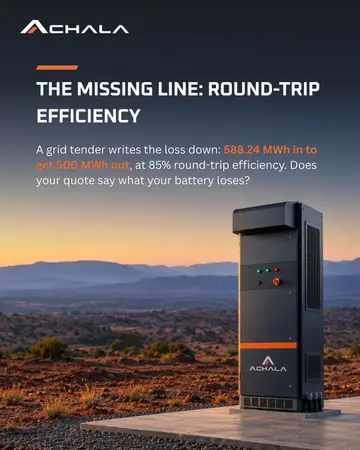
Every battery gives back less power than it takes in, and the factory pays for the difference every day. Most battery quotes never put a number on it. The ratio is called round-trip efficiency: the energy that comes out, divided by the energy that went in. A grid storage tender writes the loss down in plain numbers. In SJVN's 250 MW / 500 MWh tender, at a round-trip efficiency of 85 per cent, the buying utility must supply 588.24 MWh of charging power to get 500 MWh back. The 88.24 MWh in between is bought and never returned. A factory battery works the same way. It charges on cheaper power and gives back less of it at the peak, and the losses are paid for on the factory's own meter. So a quote that states the battery's size and its saving, but not the efficiency the saving was worked out on, has left a line out of the arithmetic. There is a second question inside the first. Is the figure the cell maker's rated value, or one measured on a running system? They are different claims, and only one has been tested on a site. The loss is real either way. The only choice is whether it is written down. Source: SJVN Limited, Request for Selection No. SJVN/CC-Delhi/REIA/2025/BESS-2, 250 MW / 500 MWh standalone battery storage, Haryana, cl. 6.7.1 (charging energy at the guaranteed round-trip efficiency).

#AchalaEnergy #TheMissingLine #RoundTripEfficiency

The post’s graphic, made for Achala Energy
LikeCommentRepostSend

Nandita Rao

Founder, Achala Energy

Tue, 4 Aug

At Pang in Ladakh, a 12 GWh battery is planned at one end of a transmission line due by 2029-30. Until that line runs, the 12 GWh is an approval, not capacity. In October 2023 the Cabinet approved the transmission to carry power from a planned 13 GW of renewables in Ladakh, with a 12 GWh battery at Pang. The line is about 713 km long, with terminals at Pang and at Kaithal in Haryana. It is due by 2029-30. That sequence is right, and I am not criticising the plan. A line through the Himalaya has to come before the generation and the storage at its end, and building one takes years. So in August 2026 the 12 GWh is a plan with a date on it. Anyone quoting it as storage India has today is counting an approval. The rest of the park is at an earlier step still. In April 2025 the minister told Parliament that no companies had yet been selected to build its renewable projects. Two months later POWERGRID invited bids for a small battery at Pang, 1.2 MWh beside 2.1 MW of solar, to power the construction work at the remote site. That is the right first battery for a building site, and it says nothing about whether the plan will be met. What I ask for is the date beside the number. A 12 GWh plan for 2029-30 is a fair thing to report. A 12 GWh battery in Ladakh today is not. The approval is real, and so is its date. The capacity comes with the line. Source: Powerline, "CCEA approves plan for 13 GW of renewable project in Ladakh", 19 October 2023 (transmission for 13 GW with 12 GWh of battery storage at Pang; about 713 km; target FY2029-30). Source: pv magazine India, "Ladakh to host 13 GW hybrid renewable energy park", 8 April 2025 (the minister: "no companies have been selected for setting up renewable power projects in this RE park"). Source: Energetica India, "POWERGRID invites bids for solar and BESS pilot project at Pang HVDC in Ladakh", 2 June 2025 (2.1 MWp solar, 300 kW / 1,200 kWh battery, for construction power).

#AchalaEnergy #EnergyStorageIndia #BESS

The post’s graphic, made for Achala Energy
LikeCommentRepostSend

Achala Energy

Thu, 6 Aug

We will not give you a payback number in a first meeting. The honest answer takes about ten days. Everyone asks for one, and it feels rude not to answer. But in a first meeting nobody has seen your consumption data, so any number said across the table is invented. That number then becomes what the whole project is judged against for the next five years. When reality comes in at six years instead of three, the conclusion is that storage doesn't work. The battery was fine. The arithmetic was made up in a meeting room. So we ask for twelve months of bills, and the meter's fifteen-minute data where it records it, and read them against your actual tariff order. You get a number in about ten days, with the working: which line of the bill each part of the saving is on. We lose deals over this. I have been told twice that we came across as evasive. I would still rather be ten days late with the right number than early with a wrong one. If someone has already given you a number, ask what consumption data it was built on. — Nandita Rao, Founder and CEO

#AchalaEnergy #IndustrialBattery #BatteryPayback

The post’s graphic, made for Achala Energy
LikeCommentRepostSend

Achala Energy

Fri, 7 Aug

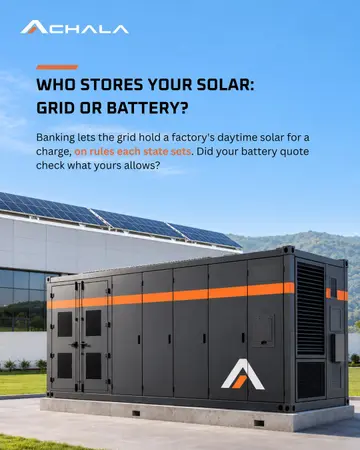
A battery takes two lines off a factory's electricity bill and adds two of its own. Most quotes show only the first two. The two it takes off are the peak-hour energy charge, because the battery covers the expensive hours with power bought cheaper, and the demand charge, because it lowers the highest demand on the meter. The two it adds are quieter. The battery loses some of every unit it stores, and it draws power to keep itself cool. Both are bought on the factory's own meter, every day it runs. Then there are the rules that decide the size of all four. The national time-of-day rule sets only a floor under the peak rate. Each state sets the hours, how demand is billed, and whether surplus solar can be banked with the grid instead of a battery. And a tariff order can move one saving one way and the other the opposite way. A payback that does not show each of these is a single number with the working hidden. Our article today goes through them line by line, with the documents behind each. Read it with your last electricity bill beside you. Every line it names is on that bill, or should be on your quote.

#AchalaEnergy #IndustrialBattery #MaximumDemandCharge

The post’s graphic, made for Achala Energy
LikeCommentRepostSend

Nandita Rao

Founder, Achala Energy

Fri, 7 Aug

A battery's payback is two savings added together, and a tariff order can move them separately. When I am shown one payback figure, I ask to see the two apart. The first saving is energy. The battery charges in the cheaper hours and discharges at the peak, so the factory buys less power at the peak rate. The second is the demand charge. The battery lowers the highest demand on the meter, and with it the monthly charge that demand sets. They sit on different lines of the bill, and the state commission sets each one separately. Karnataka's tariff order for the three years from April 2025 shows how. It cut energy charges for HT industry by 30 paise a unit for 2025-26. In the commission's own words, it "considered marginal increase in fixed / demand charges, by reducing the energy charges." For a battery, the demand-charge saving grows when the demand charge rises. The energy saving depends on the gap between the peak and the cheaper hours, which an order can move on its own. Tariffs move in pieces, not as a whole. One payback figure hides which piece is carrying it, and so which way the next order will push it. If you are asked to approve a battery, ask for the saving split into the two lines, in rupees a month, with the tariff order each rate came from. A combined figure cannot be re-checked when the next order lands. Source: Karnataka Electricity Regulatory Commission, press note, Determination of Electricity Tariff, Tariff Order dated 27 March 2025, p. 1 ("HT Industrial: Energy charges reduced by 30 paise per unit for FY2025-26") and p. 4.

#AchalaEnergy #KarnatakaIndustry #BatteryPayback

The post’s graphic, made for Achala Energy
LikeCommentRepostSend

Nandita Rao

Founder, Achala Energy

Mon, 3 Aug

For five years I sat on the scheduling side of the grid, deciding what runs in each fifteen-minute block and who pays. It taught me storage is not a hardware problem. From that desk you see two things at once. Renewable power being turned down because there is nowhere to put it. And, in the same block, somebody a hundred kilometres away paying a premium for power. It happens every day, and almost nobody outside those control rooms knows it. It makes storage look like an obvious engineering fix: put a battery between the two. Then I spent three years in Germany at a storage integrator, on the commercial side. What I learned there was that the technology was basically finished. The hard part was the contract. Who takes which risk, and what happens in year eight. I came back expecting Indian storage to be a hardware business, and found it wasn't. The batteries are available. The projects I have watched stall, stalled on paper. That is what I will write about here: why storage projects in India die at the contract stage, and almost never at the technical stage. If you work on the technical side and think I have this backwards, I would like to hear about the project that proves it. What stopped the last storage project you watched?

#AchalaEnergy #EnergyStorageIndia

LikeCommentRepostSend

Achala Energy

Wed, 5 Aug

Since 2023 the law has said a factory's peak-hour energy rate must be at least 1.2 times its normal rate. It does not say how much higher. The rule is Rule 8A of the Electricity (Rights of Consumers) Rules, added by the Ministry of Power on 14 June 2023. Every commercial and industrial consumer with a maximum demand above 10 kW was to be on a time-of-day tariff by 1 April 2024. It sets two floors. At peak hours, the energy rate cannot be less than 1.2 times the normal rate. In the eight solar hours the state commission names, it must be at least 20 per cent below it. And peak hours cannot run longer than solar hours. It applies to the energy charge only. The demand charge is a separate line. Everything else belongs to the state. Your commission sets the hours and the actual rates, and changes them in its tariff orders. The gap between the cheap hours and the peak is what a battery earns on, less its own losses. The national rule guarantees that a gap exists. It does not tell you how wide it is this year, or what it will be after the next order. So when a quote shows a time-of-day saving, ask which tariff order its rates came from, and its date. A spread copied from an old order can be out of date before the battery is installed. Which order is your quote built on? Source: Ministry of Power, Electricity (Rights of Consumers) Amendment Rules, 2023, Rule 8A (Time of Day Tariff), 14 June 2023.

#AchalaEnergy #TimeOfDayTariff #IndustrialBattery

LikeCommentRepostSend

Nandita Rao

Founder, Achala Energy

Wed, 5 Aug

I have never once lost a project because the battery wasn't good enough. Contracts stall on who carries the payment risk. Storage conversations in India run on cell chemistry, gigafactories and the price per kWh. They are worth having. In my experience they are not what decides whether a project gets built. What decides it is the contract. A grid battery earns a fixed charge for being available, paid by a state distribution company. A lender reading that contract asks one question before any other: what happens if the payments stop? Say the buyer does not pay for eleven months. Who carries those months? The developer, from its own balance sheet? The lender, by waiting? A payment security the contract may or may not contain? If the contract does not answer that, the project does not reach financial closure. And under the national support scheme, not a rupee of support moves before financial closure. That is why I call storage a contracting problem wearing a hardware costume. The hardware is just the part everyone can see. The next time a storage story leads with cell technology, look for the sentence about payment security. I rarely find one. Who carries the eleven months in the contracts you have read?

#AchalaEnergy #EnergyStorageIndia #ProjectFinance

LikeCommentRepostSend