Skip to content
NexSocials

Work AUTHORITY August 2026

Achala Energy, a fictional battery storage company.

Sizes and installs battery storage for factories, from each factory's own electricity bills. Its August 2026 on LinkedIn, planned, written and designed by NexSocials.

  • 33pieces
  • 22company page
  • 11Nandita’s profile
  • 3articles

What the month does

Shows the owner of a factory holding a battery quote which lines of his own electricity bill decide whether the payback is true.

Written for
The owner or plant head of a mid-size factory on a time-of-day tariff, holding a battery quote.
Where
Karnataka, Tamil Nadu, Maharashtra, Gujarat and Andhra Pradesh
Its themes
Read the bill before the battery · A contracting problem in a hardware costume
How often
Something goes out on every one of August’s 21 weekdays.

Five pieces from the month, at full size.

The strongest of the 33, each with why it was made this way.

The graphic: 31% OFF A FOUNDRY'S DEMAND CHARGE

01Evidence

A foundry's maximum demand charge fell 31 per cent in the first full billing cycle after its battery went in.

Single image Achala Energy’s page Mon 3 Aug

Why it was made this way

For the factory owner holding a quote, who fears signing a payback that turns out wrong.

What a battery takes off a factory's bill, and what it adds

A battery quote's payback is two savings and two costs added together. Each is set by a document the factory can read. Here they are, line by line.

A battery quote usually arrives with one number on the front page: the payback, in years. Three, perhaps four.

That number is a sum. Behind it are two savings the battery makes on the factory's electricity bill and two costs it adds to the same bill, and the size of every one of them is set by a document the factory can read for itself. A quote that shows the sum and not the parts is asking to be believed rather than checked.

… 5 minutes to read in full

03

What a battery actually saves a factory

Article Achala Energy’s page Fri 7 Aug

Nandita RaoFounder and CEO, Achala Energy

For five years I sat on the scheduling side of the grid, deciding what runs in each fifteen-minute block and who pays. It taught me storage is not a hardware problem.

From that desk you see two things at once. Renewable power being turned down because there is nowhere to put it.

And, in the same block, somebody a hundred kilometres away paying a premium for power.

…

04Point of view

Why storage stalls at the contract

Text post Nandita Rao’s profile Mon 3 Aug

Why it was made this way

For engineers and investors who fear backing the wrong bottleneck.

The graphic: NOT FROM US. NOT YET.

05Evidence

The most useful thing we told one factory was not to buy a battery from anyone, us included.

Article post Achala Energy’s page Thu 27 Aug

Why it was made this way

For the factory owner who asked for a payback and fears a vague answer that costs him a month.

The whole month: all 33 pieces.

In the order they go out. Tap any piece to see it in the month on LinkedIn.

Achala Energy’s pageNandita Rao’s profile

Four questions to ask before anyone writes for you.

Each answered from Achala Energy’s month, not from a promise.

  1. 1Will it sound like us?

    Two voices in one month: the company’s, and Nandita Rao’s own. Both come from one form of 20 questions, filled in once.

    Achala Energy’s page
    A foundry's maximum demand charge fell 31 per cent in the first full billing cycle after its battery went in. We read that figure from the foundry's own bill.
    Nandita Rao’s profile
    For five years I sat on the scheduling side of the grid, deciding what runs in each fifteen-minute block and who pays. It taught me storage is not a hardware problem.
    See the form
  2. 2Will it be accurate?

    19 of the 33 pieces end on a Source line, naming the document behind them, so a reader can check it. One, word for word:

    Source: Ministry of Power, Electricity (Rights of Consumers) Amendment Rules, 2023, Rule 8A (Time of Day Tariff), 14 June 2023.

    The month cites, among others

    • SJVN Limited
    • Ministry of Power
    • Maharashtra Electricity Regulatory Commission
    • Karnataka Electricity Regulatory Commission
    • Deccan Chamber of Commerce Industries & Agriculture
  3. 3Will it take my time?

    Your side of a month like this one: under 30 minutes. The form once, then approvals on your phone.

    1. You, onceThe form of 20 questions
    2. NexSocialsThe plan, the writing, the design, the sources
    3. You, on your phoneApprove the month’s plan, then each week’s posts
    See how a month works
  4. 4What will the posts do?

    More than announce. Of the month’s 28 planned posts:

    • 9explain how something works
    • 4show evidence: a figure, a record, a clause
    • 11give a point of view, in the voice of a person
    • 4say what the company does, and for whom

    And two for days the country marks, outside the plan.

33 pieces, one August. Your month starts with a visibility report.

We read your page and your profile the way your buyers do, and tell you what a month like this would say for you.

Achala Energy Private Limited and its people are fictional, made for this demonstration. The documents its posts cite are real, and named in their Source lines, so each one can be checked.

Preview How Achala Energy’s August 2026 appears on LinkedIn on LinkedIn

Achala Energy

Sizes and installs battery storage for factories, from each factory's own electricity bills.

Battery storage for factories

  1. Achala Energy

    Battery storage for factories

    3 Aug Public

    A foundry's maximum demand charge fell 31 per cent in the first full billing cycle after its battery went in. We read that figure from the foundry's

    A foundry's maximum demand charge fell 31 per cent in the first full billing cycle after its battery went in. We read that figure from the foundry's own bill. Most battery savings you will see are reported from the seller's own monitoring. This one is not. It is the demand charge line on the foundry's electricity bill: the first full month after the battery, against the month before. The demand charge is the part of an HT bill set by the highest demand the factory draws, billed in rupees per kVA every month. A foundry's furnaces make that peak sharp and short, which is the kind of peak a battery can shave. It is one line and one billing cycle. It is not an annual saving, and it is not a payback. The energy charge, the battery's own losses and its cooling all sit elsewhere on the same bill, and a payback has to count every one of them. We lead with it anyway, because it is the one kind of number a factory owner can check for himself. If the quote on your desk promises a demand-charge saving, your bill is where it will show up, or not. The 31 per cent sits on one line of the foundry's bill. A saving nobody can point to on a line of yours is a promise with nothing to test it against.

    #AchalaEnergy #MaximumDemandCharge #IndustrialBattery

    The graphic: 31% OFF A FOUNDRY'S DEMAND CHARGE
    LikeCommentRepostSend
  2. Achala Energy

    Battery storage for factories

    4 Aug Public

    Every battery gives back less power than it takes in, and the factory pays for the difference every day. Most battery quotes never put a number on

    Every battery gives back less power than it takes in, and the factory pays for the difference every day. Most battery quotes never put a number on it. The ratio is called round-trip efficiency: the energy that comes out, divided by the energy that went in. A grid storage tender writes the loss down in plain numbers. In SJVN's 250 MW / 500 MWh tender, at a round-trip efficiency of 85 per cent, the buying utility must supply 588.24 MWh of charging power to get 500 MWh back. The 88.24 MWh in between is bought and never returned. A factory battery works the same way. It charges on cheaper power and gives back less of it at the peak, and the losses are paid for on the factory's own meter. So a quote that states the battery's size and its saving, but not the efficiency the saving was worked out on, has left a line out of the arithmetic. There is a second question inside the first. Is the figure the cell maker's rated value, or one measured on a running system? They are different claims, and only one has been tested on a site. The loss is real either way. The only choice is whether it is written down.

    Source: SJVN Limited, Request for Selection No. SJVN/CC-Delhi/REIA/2025/BESS-2, 250 MW / 500 MWh standalone battery storage, Haryana, cl. 6.7.1 (charging energy at the guaranteed round-trip efficiency).

    #AchalaEnergy #TheMissingLine #RoundTripEfficiency

    The graphic: THE MISSING LINE: ROUND-TRIP EFFICIENCY
    LikeCommentRepostSend
  3. Achala Energy

    Battery storage for factories

    5 Aug Public

    Since 2023 the law has said a factory's peak-hour energy rate must be at least 1.2 times its normal rate. It does not say how much higher

    Since 2023 the law has said a factory's peak-hour energy rate must be at least 1.2 times its normal rate. It does not say how much higher. The rule is Rule 8A of the Electricity (Rights of Consumers) Rules, added by the Ministry of Power on 14 June 2023. Every commercial and industrial consumer with a maximum demand above 10 kW was to be on a time-of-day tariff by 1 April 2024. It sets two floors. At peak hours, the energy rate cannot be less than 1.2 times the normal rate. In the eight solar hours the state commission names, it must be at least 20 per cent below it. And peak hours cannot run longer than solar hours. It applies to the energy charge only. The demand charge is a separate line. Everything else belongs to the state. Your commission sets the hours and the actual rates, and changes them in its tariff orders. The gap between the cheap hours and the peak is what a battery earns on, less its own losses. The national rule guarantees that a gap exists. It does not tell you how wide it is this year, or what it will be after the next order. So when a quote shows a time-of-day saving, ask which tariff order its rates came from, and its date. A spread copied from an old order can be out of date before the battery is installed. Which order is your quote built on?

    Source: Ministry of Power, Electricity (Rights of Consumers) Amendment Rules, 2023, Rule 8A (Time of Day Tariff), 14 June 2023.

    #AchalaEnergy #TimeOfDayTariff #IndustrialBattery

    LikeCommentRepostSend
  4. Achala Energy

    Battery storage for factories

    6 Aug Public

    Signed by Nandita Rao

    We will not give you a payback number in a first meeting. The honest answer takes about ten days

    We will not give you a payback number in a first meeting. The honest answer takes about ten days. Everyone asks for one, and it feels rude not to answer. But in a first meeting nobody has seen your consumption data, so any number said across the table is invented. That number then becomes what the whole project is judged against for the next five years. When reality comes in at six years instead of three, the conclusion is that storage doesn't work. The battery was fine. The arithmetic was made up in a meeting room. So we ask for twelve months of bills, and the meter's fifteen-minute data where it records it, and read them against your actual tariff order. You get a number in about ten days, with the working: which line of the bill each part of the saving is on. We lose deals over this. I have been told twice that we came across as evasive. I would still rather be ten days late with the right number than early with a wrong one. If someone has already given you a number, ask what consumption data it was built on. — Nandita Rao, Founder and CEO

    #AchalaEnergy #IndustrialBattery #BatteryPayback

    Quote card: The battery was fine. The arithmetic was made up in a meeting room.
    LikeCommentRepostSend
  5. Achala Energy

    Battery storage for factories

    7 Aug Public

    A battery takes two lines off a factory's electricity bill and adds two of its own. Most quotes show only the first two

    A battery takes two lines off a factory's electricity bill and adds two of its own. Most quotes show only the first two. The two it takes off are the peak-hour energy charge, because the battery covers the expensive hours with power bought cheaper, and the demand charge, because it lowers the highest demand on the meter. The two it adds are quieter. The battery loses some of every unit it stores, and it draws power to keep itself cool. Both are bought on the factory's own meter, every day it runs. Then there are the rules that decide the size of all four. The national time-of-day rule sets only a floor under the peak rate. Each state sets the hours, how demand is billed, and whether surplus solar can be banked with the grid instead of a battery. And a tariff order can move one saving one way and the other the opposite way. A payback that does not show each of these is a single number with the working hidden. Our article today goes through them line by line, with the documents behind each. Read it with your last electricity bill beside you. Every line it names is on that bill, or should be on your quote.

    #AchalaEnergy #IndustrialBattery #MaximumDemandCharge

    The graphic: TWO LINES OFF YOUR BILL. TWO ADDED.
    LikeCommentRepostSend
  6. Achala Energy

    Battery storage for factories

    7 Aug Public

    LikeCommentRepostSend
  1. Achala Energy

    Battery storage for factories

    10 Aug Public

    This matters if your factory is in Maharashtra and was quoted a battery in 2025. The order behind that quote has been rewritten since

    This matters if your factory is in Maharashtra and was quoted a battery in 2025. The order behind that quote has been rewritten since. On 28 March 2025 the state commission issued its tariff order for the years from April 2025. On 25 June 2025 it revised that order, on the distribution company's review petition. On 3 November 2025 the Bombay High Court set the June order aside. On 17 November the Supreme Court sent the matter back to the commission to be heard again. The commission decided it afresh on 25 March 2026. Among the parts in dispute were the time-of-day hours and rebates. Those are the numbers a battery's energy saving is built on. So a payback worked out in April 2025 was not wrong on the day it was made. It was built on a table that has since been revised, set aside and decided again. Nobody need have made a mistake for the number on your desk to be out of date. It only needs nobody to have re-run it. A payback is only as current as the order it was worked out on. This one was decided, revised, set aside, sent back and decided again inside twelve months.

    Source: Deccan Chamber of Commerce Industries & Agriculture, Pune, Circular No. 085/GEN/2025-26, 27 March 2026 (MERC's order of 25 March 2026 on MSEDCL's review petition, and the dates before it). Source: Maharashtra Electricity Regulatory Commission, Order in Case No. 75 of 2025 (post remand), 25 March 2026, paras 4.3.20–4.3.27 (the time-of-day objections).

    #AchalaEnergy #MaharashtraIndustry #TimeOfDayTariff

    The graphic: QUOTED IN 2025? THE TARIFF WAS DECIDED AGAIN
    LikeCommentRepostSend
  2. Achala Energy

    Battery storage for factories

    11 Aug Public

    A battery's capacity falls every year, and a grid tender writes down exactly how far. Most factory quotes assume year one forever

    A battery's capacity falls every year, and a grid tender writes down exactly how far. Most factory quotes assume year one forever. In SJVN's grid storage tender, the developer must keep a minimum share of the battery's original capacity in every contract year. The floor is 97.5 per cent at the end of year one. Then 95, 92.5, 90, 87.5 and 85. At year seven it is 82.5 per cent. The developer pays to hold that line, by replacing or adding cells at its own cost. A factory battery loses capacity too. A smaller battery shifts less peak energy and shaves less off the demand peak, so the saving shrinks with it. A payback worked out on the capacity of a new battery therefore overstates every year after the first. By how much depends on how fast the capacity falls, and on whether anyone has promised to put it back. The question is not whether capacity falls. It is how far the quote assumed it falls, by which year, and who pays. A capacity floor nobody wrote down is a floor nobody has to keep.

    Source: SJVN Limited, Request for Selection No. SJVN/CC-Delhi/REIA/2025/BESS-2, cl. 6.7.1.iv (minimum dispatchable capacity by contract year) and cl. 6.7.1.ix (replacement at the developer's cost).

    #AchalaEnergy #TheMissingLine #BatteryDegradation

    The graphic: THE MISSING LINE: CAPACITY BY YEAR
    LikeCommentRepostSend
  3. Achala Energy

    Battery storage for factories

    12 Aug Public

    Your electricity bill shows the month's highest demand, but not when it came or how long it lasted. A battery is sized on both

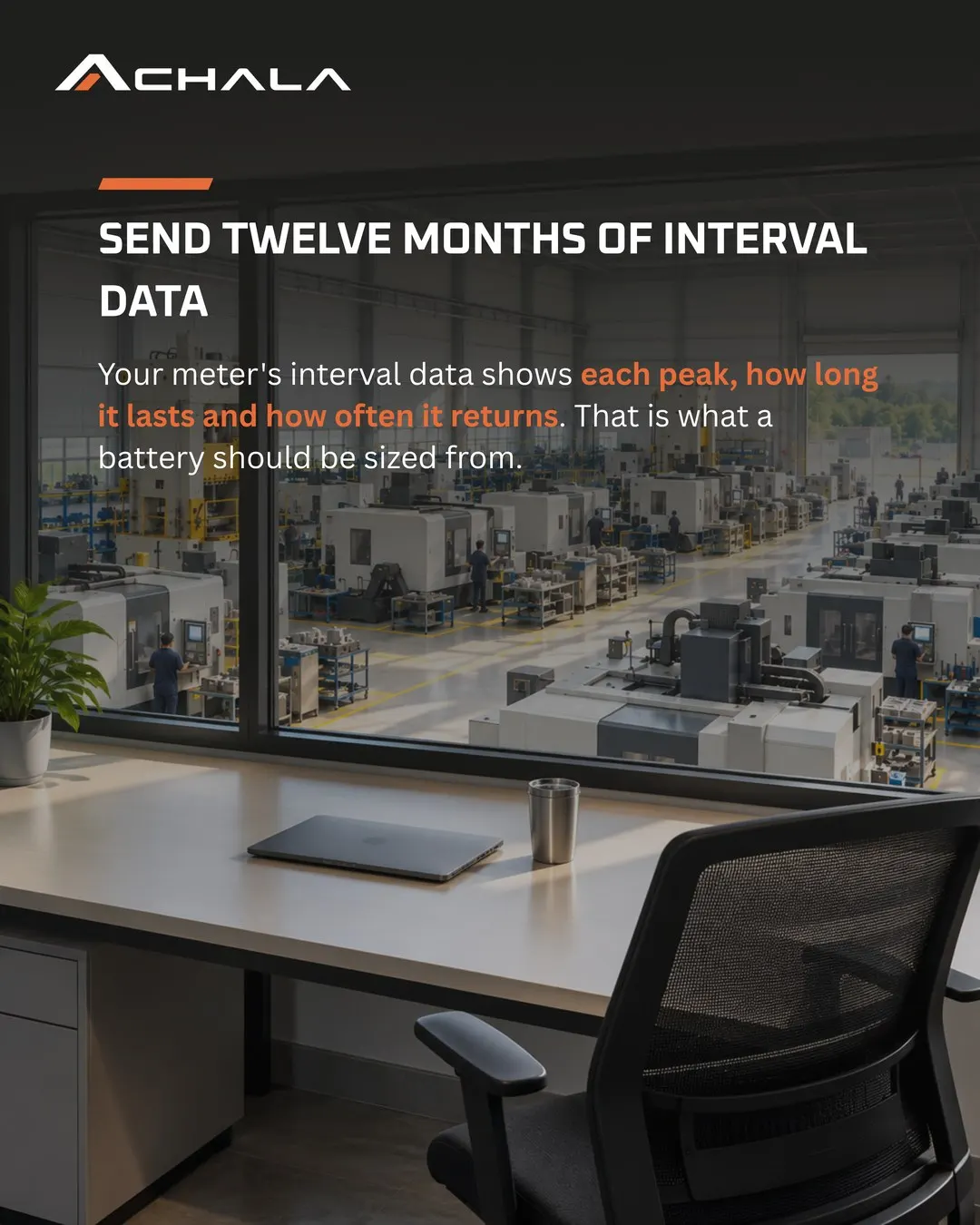
    Your electricity bill shows the month's highest demand, but not when it came or how long it lasted. A battery is sized on both. The demand charge is billed on the highest demand recorded in the month. On a factory that is often one short interval: a furnace starting, two presses running together, a shift change. In some tariffs that one interval costs more than a month. Under Maharashtra's tariff for 2020 to 2025, an HT factory's billing demand was the highest of three figures. The month's actual peak between 6 am and 10 pm. Seventy-five per cent of its highest billing demand in the previous eleven months. And a share of its contract demand. One spike kept a floor under the bill for most of a year. A battery sized from a monthly bill sees the peak and none of its shape. It can be too small for the interval that sets the charge, or larger than the factory needs. That is why we ask for twelve months of the meter's fifteen-minute data before we size anything. It shows each peak, how long it lasts, and how often it comes back. Check how your state bills demand, and whether your quote was sized from monthly figures or interval data. Monthly figures cannot show the interval that sets your bill.

    Source: Maharashtra Electricity Regulatory Commission, Order in Case No. 322 of 2019, 30 March 2020, p. 718 (billing demand, HT tariff categories), as reproduced in MSEDCL Commercial Circular No. 323, 3 April 2020, p. 72. The rule for the 2020–25 control period.

    #AchalaEnergy #MaximumDemandCharge #IndustrialBattery

    What a monthly bill hides about your factory's demand4 pages

    Page 1 of 4: YOUR BILL SHOWS THE PEAK, NOT ITS SHAPEPage 2 of 4: ONE INTERVAL CAN SET THE CHARGEPage 3 of 4: ONE SPIKE, ELEVEN MONTHSPage 4 of 4: SEND TWELVE MONTHS OF INTERVAL DATA
    LikeCommentRepostSend
  4. Achala Energy

    Battery storage for factories

    13 Aug Public

    In 2024-25 the government budgeted ₹96 crore to support battery storage, later cut it to ₹46 crore, and spent none of it. The batteries were not the

    In 2024-25 the government budgeted ₹96 crore to support battery storage, later cut it to ₹46 crore, and spent none of it. The batteries were not the reason. The minister's reply in Parliament, reported in April 2025, gave the reason: no storage project reached financial closure that year. That is the scheme's design working as written. As sanctioned in March 2024, the first 10 per cent of support is paid only at financial closure, and only against a bank guarantee and 90 per cent of the land in hand. The largest share, 45 per cent, waits until the battery starts running. The rest comes in three annual instalments of 15 per cent. So the support follows a project. It does not start one, and it cannot rescue one that never reaches closure. A developer has to sign the purchase agreement, secure the land, raise the debt and build before most of it arrives. None of those is a battery problem. Every one is a contract: with the buyer, the landowner, the lender. That is where the year's money waited. A scheme's outlay tells you what the government is willing to pay. Financial closure tells you what is actually being built.

    Source: Minister of State for Power, reply in Parliament, as reported by pv magazine India, 4 April 2025 ("A budgetary provision of INR 96 crore was made for 1000 MWh BESS in 2024-25"; "the budgetary allocation was revised from INR 96 crore to INR 46 crore"; none of the projects reached financial closure). Source: Ministry of Power, Sanction Order F.No. 42-26/1/2022-RCM (Part 1), 15 March 2024, Scheme for Viability Gap Funding for Battery Energy Storage Systems, paras 2 and 4 (tranches). Its target was raised to 13.2 GWh in March 2025 on the same tranches (pv magazine India, 20 March 2025). Source: Ministry of Power, F.No. 48-15/7/2025-NRE, 9 June 2025, and its amendment of 4 August 2025: a second scheme, funded through the Power System Development Fund, with its own tranches.

    #AchalaEnergy #EnergyStorageIndia #ProjectFinance

    Where India's storage support money waited in 2024-254 pages

    Page 1 of 4: ₹96 CRORE BUDGETED. NONE SPENT.Page 2 of 4: THE FIRST 10% WAITS FOR CLOSUREPage 3 of 4: THE BIGGEST SHARE WAITS FOR IT TO RUNPage 4 of 4: EVERY STEP IS A CONTRACT
    LikeCommentRepostSend
  5. Achala Energy

    Battery storage for factories

    14 Aug Public

    If your state lets your factory bank daytime solar and draw it later, the grid is already doing part of a battery's job. The banking rules decide what

    If your state lets your factory bank daytime solar and draw it later, the grid is already doing part of a battery's job. The banking rules decide what a battery is worth. Banking lets a factory with its own or open-access solar put surplus daytime power into the grid and take it back later, for a charge the state commission sets. The national green open access rules of June 2022 require banking to be allowed at least once a month for consumers of 100 kW and above. How much may be banked, what it costs and when it may be drawn are left to each state. The limits matter more than the headline rule, because they decide which hours the banked power can cover. In Maharashtra, the distribution company reads the state's open access regulations as forbidding power banked in a cheaper time slot from being drawn in a costlier one. Where that reading holds, banked solar cannot cover the evening peak. A battery can. So the same battery is worth one thing in a state that lets the grid hold your solar cheaply, and another in a state that does not. Before you pay a battery to hold your solar, has anyone checked what the grid would charge to hold it for you?

    Source: Ministry of Power, Electricity (Promoting Renewable Energy Through Green Energy Open Access) Rules, 2022, 6 June 2022 (banking at least on a monthly basis; eligibility from 100 kW). Source: Maharashtra Electricity Regulatory Commission, Order in Case No. 75 of 2025 (post remand), 25 March 2026, para 4.3.21 (MSEDCL's submission on Regulation 20.3 of the MERC Distribution Open Access Regulations).

    #AchalaEnergy #OpenAccess #IndustrialBattery

    The graphic: WHO STORES YOUR SOLAR: GRID OR BATTERY?
    LikeCommentRepostSend
  6. Achala Energy

    Battery storage for factories

    15 Aug Public

    Wishing everyone a happy 80th Independence Day. Today is for everyone who keeps this country's work going: in its towns, its workshops and its

    Wishing everyone a happy 80th Independence Day. Today is for everyone who keeps this country's work going: in its towns, its workshops and its factories, and on the grid that powers them. From all of us in Karnataka, Tamil Nadu, Maharashtra, Gujarat and Andhra Pradesh, where our batteries run, a proud and peaceful day. Happy Independence Day.

    #AchalaEnergy #IndependenceDay

    The graphic: HAPPY 80TH INDEPENDENCE DAY
    LikeCommentRepostSend
  1. Achala Energy

    Battery storage for factories

    17 Aug Public

    Roughly a third of our first meetings with factory owners end with us saying they don't need a battery yet. It is the most useful thing we do

    Roughly a third of our first meetings with factory owners end with us saying they don't need a battery yet. It is the most useful thing we do. It usually comes after the second question. Not "how big is your factory" but "what does your bill look like". The bill decides it. A battery earns on a peak worth shaving and on a gap between the cheap hours and the peak that is wide enough to cover its own losses. If the demand is flat, or the gap is narrow, it has little to earn. And if the contract demand is about to change, any sizing done now is a sizing for a factory that will not exist in a year. In each of those cases the honest answer is: not yet, and here is what would have to change first. It costs us the sale. We think it is also the single biggest reason the referrals keep coming. None of this is generosity. A battery sold to a factory that did not need one becomes the story everyone tells about storage not working. If you were sold a battery and the saving never came, the answer is usually in the bill from before you bought it. What does yours show?

    #AchalaEnergy #IndustrialBattery

    LikeCommentRepostSend
  2. Achala Energy

    Battery storage for factories

    18 Aug Public

    Every battery uses power to keep itself cool, and in the hottest months it uses the most. That load sits on your meter

    Every battery uses power to keep itself cool, and in the hottest months it uses the most. That load sits on your meter. A battery's cells have to stay inside a temperature range, so the system runs its own cooling and controls. It draws power to do that all year, and hardest when the weather is hottest. A grid storage tender treats this as a line of its own. In SJVN's tender the system's own consumption is metered separately and is entirely the developer's cost. That includes every expense of connecting it: the line extension, the panel, the ring main unit. A factory battery has the same load and usually no such line. The cooling draws from the factory's own supply, at the factory's own tariff, whether the battery is charging or standing idle. If the quote's saving was worked out before that load is taken off, the saving on paper is larger than the one the bill will show. It is an easy line to leave out, because it never appears on the battery's datasheet. It appears on the electricity bill. The number to look for is what the system draws for its own use in the hottest month. If the quote has none, its saving has not been netted.

    Source: SJVN Limited, Request for Selection No. SJVN/CC-Delhi/REIA/2025/BESS-2, cl. 6.7.1.iii (auxiliary consumption metered separately and chargeable to the developer, with the cost of the connection).

    #AchalaEnergy #TheMissingLine #IndustrialBattery

    The graphic: THE MISSING LINE: THE BATTERY'S OWN POWER
    LikeCommentRepostSend
  3. Achala Energy

    Battery storage for factories

    19 Aug Public

    A storage project in India can have the tender, the technology and the scheme money ready, and still not be built. It waits on contracts

    A storage project in India can have the tender, the technology and the scheme money ready, and still not be built. It waits on contracts. Follow one grid battery from award to running and count the signatures. The buyer signs a purchase agreement that decides who supplies the charging power and how the battery is paid. The developer secures the land. A lender reaches financial closure on the strength of all of that. Only then does the scheme's first support move. After that come the guarantees that run for years: availability every month, capacity in every contract year, and a penalty for each. At every one of those steps a project can stop without anything being wrong with the battery. Its maker can deliver, the cells can be tested, and the project still waits for a signature. That is the argument Nandita Rao makes in her article today, step by step, with the documents behind each one. It is also the reason we read a factory's contract terms as carefully as its load: a battery that is right on paper and wrong in the contract is still the wrong battery. Read it with the last storage headline you saw in mind. Ask which of these steps the project in it had actually passed.

    #AchalaEnergy #EnergyStorageIndia #ProjectFinance

    The graphic: READY TO BUILD. WAITING TO SIGN.
    LikeCommentRepostSend
  4. Achala Energy

    Battery storage for factories

    20 Aug Public

    Happy Akshay Urja Diwas to everyone who builds and runs India's renewable energy. Today marks the people who plan it, build it and keep it running

    Happy Akshay Urja Diwas to everyone who builds and runs India's renewable energy. Today marks the people who plan it, build it and keep it running, and, more and more, the people who store it for the hours it is needed. India added 4.6 GWh of battery storage in the first three months of 2026 alone, on Mercom India's count (16 June 2026). To everyone keeping the power steady, thank you.

    #AchalaEnergy #AkshayUrjaDiwas

    The graphic: HAPPY AKSHAY URJA DIWAS
    LikeCommentRepostSend
  5. Achala Energy

    Battery storage for factories

    21 Aug Public

    Signed by Nandita Rao

    I would rather be thought of as slightly boring and reliably correct about tariff structures than as visionary. That is a choice, not modesty

    I would rather be thought of as slightly boring and reliably correct about tariff structures than as visionary. That is a choice, not modesty. There are enough people at conferences describing what Indian energy will look like in 2047. There are very few who can tell a factory owner what his demand charge does to a battery's return this year. The second is what decides whether a factory should buy a battery. Which hours his state calls peak. How his demand is billed. What his last tariff order changed. Whether he can bank power. None of it is visionary, and all of it is checkable. That is the work we do before we quote: twelve months of bills, read against the order that actually applies to the factory. It is slower than a vision and much less exciting to present. But a factory owner can hold us to every number in it, because every rate in it carries the order it came from and that order's date. If that makes us the boring option in the room, it is the reputation I want. We would rather be checked than believed. — Nandita Rao, Founder and CEO

    #AchalaEnergy #IndustrialBattery #TimeOfDayTariff

    Quote card: None of it is visionary, and all of it is checkable.
    LikeCommentRepostSend
  1. Achala Energy

    Battery storage for factories

    24 Aug Public

    This matters if your factory in Karnataka has a smart or AMR meter. Your bill may soon have to say how often the power failed

    This matters if your factory in Karnataka has a smart or AMR meter. Your bill may soon have to say how often the power failed. Today an HT bill shows what you used and your highest demand. It does not show how many times the supply failed, or for how long. That record stays with the distribution company. Karnataka's commission published draft Electricity Supply Regulations in the state gazette on 14 August 2026. Its own summary says that for smart and AMR meters, the bill "shall provide the details of total numbers and total hours of interruptions of supply", downloadable from the website too. It would apply to every HT factory with such a meter. It sits beside a directive already in the 2025 tariff order: from April 2026, outages beyond 60 minutes a month are to be compensated by a cut in the demand charge. What to do: comments are open for 30 days from the gazette date. If it is adopted, read the new line on your bill. It would be the first written count of the outages a battery could have carried you through. A draft, not yet a rule. But the number it asks for is one factory owners have never had on paper.

    Source: Karnataka Electricity Regulatory Commission, Notice No. KERC/DDD/ESR/2026-27/2386, 17 August 2026 (draft published in the Official Gazette of Karnataka on 14 August 2026; comments within 30 days). Source: Karnataka Electricity Regulatory Commission, Highlights of the changes proposed in the Draft KERC (Electricity Supply Regulations) (ESR) 2026, item 13 (Billing). Source: Karnataka Electricity Regulatory Commission, press note on the Tariff Order dated 27 March 2025, p. 2 (the outage directive).

    #AchalaEnergy #KarnatakaIndustry #PowerOutages

    The graphic: YOUR BILL MAY COUNT YOUR OUTAGES
    LikeCommentRepostSend
  2. Achala Energy

    Battery storage for factories

    25 Aug Public

    A grid storage tender says plainly that battery storage is prone to fire. Your factory's battery sits beside your plant

    A grid storage tender says plainly that battery storage is prone to fire. Your factory's battery sits beside your plant. SJVN's grid storage tender states that battery storage is prone to fire hazard, and requires a fire barrier between the switchyard and the battery. CEA's safety regulations, as cited in the market, add fire detection and automatic suppression for ground-mounted systems. Barrier, detection, suppression, spacing and the approach road are all named in the tender. They are also the items most easily left out of a low bid, because none of them changes the battery's size or its saving. A factory puts its battery close to its own sheds, stock and people. The fire scope is not an optional extra. It is what an inspector or an insurer will want to see before anything else. So when two quotes for the same battery differ in price, the fire scope is one of the first places to look for the difference. It is also the hardest part to add once the battery is installed. Ask for the fire scope line by line: barrier, detection, suppression, spacing, access. A line missing from the price is a line missing from the site.

    Source: SJVN Limited, Request for Selection No. SJVN/CC-Delhi/REIA/2025/BESS-2, cl. 6.5.5 (fire hazard; fire barrier between the switchyard and the battery). Source: Central Electricity Authority (Measures relating to Safety and Electric Supply) Regulations, 2023, Regulation 121, as cited in trade reports (detection and automatic suppression).

    #AchalaEnergy #TheMissingLine #BatterySafety

    The graphic: THE MISSING LINE: FIRE SCOPE
    LikeCommentRepostSend
  3. Achala Energy

    Battery storage for factories

    27 Aug Public

    The most useful thing we told one factory was not to buy a battery from anyone, us included. Fourteen months later, it made sense

    The most useful thing we told one factory was not to buy a battery from anyone, us included. Fourteen months later, it made sense. Between those two answers, nothing about the battery changed. The factory's contract demand did. That is the part of a payback no first meeting can see. It sits in twelve months of the factory's own bills and its meter's fifteen-minute data, read against the tariff order that actually applies to it. The bills show how the demand is billed. The interval data shows when the peaks come and how long they last. The order shows the hours and the rates. Put together, they say whether a battery pays at all, and how large it should be. Sometimes the answer is that it doesn't, yet. Then the useful thing is to say so before anyone spends money, and to say what would make the answer yes. Nandita Rao's article today explains why we will not quote a payback before we have read all of that, and tells the story of the factory we turned away. If you have a battery quote, read it alongside the article. Ask which of those three documents your number was built from.

    #AchalaEnergy #IndustrialBattery #BatteryPayback

    The graphic: NOT FROM US. NOT YET.
    LikeCommentRepostSend
  4. Achala Energy

    Battery storage for factories

    28 Aug Public

    Two batteries of the same size can wear out at very different speeds. The datasheet rarely says at what pace

    Two batteries of the same size can wear out at very different speeds. The datasheet rarely says at what pace. A battery's life is counted in cycles: one full charge and discharge. How many it gives before its capacity falls to an agreed floor depends on the cells, and on how hard and how often they are worked. The national grid storage scheme assesses grid batteries at well over one full cycle a day, across the whole year, and lets the grid operator raise that. A factory battery can be worked as hard or harder. If your tariff has a morning and an evening peak, and the battery covers both, it runs about two cycles a day. So a cycle-life figure only means something beside the number of cycles your own tariff needs. Two quotes can show the same capacity and the same life in years, and assume very different daily use to get there. There is one more check. A cycle life can be the cell maker's rated figure or a field measurement. The two should never be mixed in one number. A cycle life with no daily pace beside it is half a figure. How many cycles a day did your quote assume?

    Source: Ministry of Power, Operational Guidelines of the Scheme for Viability Gap Funding for Battery Energy Storage Systems, 15 March 2024, cl. 4.1 (the cycles a year a grid battery is assessed at, which NLDC may increase).

    #AchalaEnergy #BatteryDegradation #IndustrialBattery

    LikeCommentRepostSend
  1. Achala Energy

    Battery storage for factories

    31 Aug Public

    A grid battery in India is paid for being ready, not for the energy it delivers. A factory's battery is paid only through its own bill

    A grid battery in India is paid for being ready, not for the energy it delivers. A factory's battery is paid only through its own bill. In the standalone grid storage tenders, the developer earns a capacity charge, quoted in rupees per MW per month, for keeping the system available. The buying utility supplies the power to charge it. The price is found by reverse auction. In SJVN's 250 MW / 500 MWh tender, each bid must come in at least ₹1,000 per MW per month below the last. A factory battery has no capacity charge. Nobody pays it for being ready. It earns only what it takes off the factory's bill: energy moved out of the peak hours, and a lower demand charge. Its own losses and its cooling are paid for on that same bill. So the economics of grid storage do not carry over to a factory quote. A tender's price per megawatt says nothing about what a battery will save your plant. The checks are different too. Not the price per megawatt, but which bill lines the saving sits on, which tariff order set those rates, and what the battery draws for itself. And then whether the saving still holds in the years after the first. A price per megawatt is the right number for a grid battery, and the wrong one for yours. What was the last battery price you read actually paying for?

    Source: SJVN Limited, Request for Selection No. SJVN/CC-Delhi/REIA/2025/BESS-2, the reverse auction clause (tariff in rupees per MW per month; minimum decrement of INR 1,000 per MW per month).

    #AchalaEnergy #IndustrialBattery #BatteryPayback

    LikeCommentRepostSend

August 2026 ends here: 22 posts on Achala Energy’s page.

Nandita Rao

Founder and CEO, Achala Energy

  1. Nandita Rao

    Founder and CEO, Achala Energy

    3 Aug Public

    For five years I sat on the scheduling side of the grid, deciding what runs in each fifteen-minute block and who pays. It taught me storage is not a

    For five years I sat on the scheduling side of the grid, deciding what runs in each fifteen-minute block and who pays. It taught me storage is not a hardware problem. From that desk you see two things at once. Renewable power being turned down because there is nowhere to put it. And, in the same block, somebody a hundred kilometres away paying a premium for power. It happens every day, and almost nobody outside those control rooms knows it. It makes storage look like an obvious engineering fix: put a battery between the two. Then I spent three years in Germany at a storage integrator, on the commercial side. What I learned there was that the technology was basically finished. The hard part was the contract. Who takes which risk, and what happens in year eight. I came back expecting Indian storage to be a hardware business, and found it wasn't. The batteries are available. The projects I have watched stall, stalled on paper. That is what I will write about here: why storage projects in India die at the contract stage, and almost never at the technical stage. If you work on the technical side and think I have this backwards, I would like to hear about the project that proves it. What stopped the last storage project you watched?

    #AchalaEnergy #EnergyStorageIndia

    LikeCommentRepostSend
  2. Nandita Rao

    Founder and CEO, Achala Energy

    4 Aug Public

    At Pang in Ladakh, a 12 GWh battery is planned at one end of a transmission line due by 2029-30. Until that line runs, the 12 GWh is an approval, not

    At Pang in Ladakh, a 12 GWh battery is planned at one end of a transmission line due by 2029-30. Until that line runs, the 12 GWh is an approval, not capacity. In October 2023 the Cabinet approved the transmission to carry power from a planned 13 GW of renewables in Ladakh, with a 12 GWh battery at Pang. The line is about 713 km long, with terminals at Pang and at Kaithal in Haryana. It is due by 2029-30. That sequence is right, and I am not criticising the plan. A line through the Himalaya has to come before the generation and the storage at its end, and building one takes years. So in August 2026 the 12 GWh is a plan with a date on it. Anyone quoting it as storage India has today is counting an approval. The rest of the park is at an earlier step still. In April 2025 the minister told Parliament that no companies had yet been selected to build its renewable projects. Two months later POWERGRID invited bids for a small battery at Pang, 1.2 MWh beside 2.1 MW of solar, to power the construction work at the remote site. That is the right first battery for a building site, and it says nothing about whether the plan will be met. What I ask for is the date beside the number. A 12 GWh plan for 2029-30 is a fair thing to report. A 12 GWh battery in Ladakh today is not. The approval is real, and so is its date. The capacity comes with the line.

    Source: Powerline, "CCEA approves plan for 13 GW of renewable project in Ladakh", 19 October 2023 (transmission for 13 GW with 12 GWh of battery storage at Pang; about 713 km; target FY2029-30). Source: pv magazine India, "Ladakh to host 13 GW hybrid renewable energy park", 8 April 2025 (the minister: "no companies have been selected for setting up renewable power projects in this RE park"). Source: Energetica India, "POWERGRID invites bids for solar and BESS pilot project at Pang HVDC in Ladakh", 2 June 2025 (2.1 MWp solar, 300 kW / 1,200 kWh battery, for construction power).

    #AchalaEnergy #EnergyStorageIndia #BESS

    The graphic: 12 GWH PLANNED. THE LINE COMES FIRST.
    LikeCommentRepostSend
  3. Nandita Rao

    Founder and CEO, Achala Energy

    5 Aug Public

    I have never once lost a project because the battery wasn't good enough. Contracts stall on who carries the payment risk

    I have never once lost a project because the battery wasn't good enough. Contracts stall on who carries the payment risk. Storage conversations in India run on cell chemistry, gigafactories and the price per kWh. They are worth having. In my experience they are not what decides whether a project gets built. What decides it is the contract. A grid battery earns a fixed charge for being available, paid by a state distribution company. A lender reading that contract asks one question before any other: what happens if the payments stop? Say the buyer does not pay for eleven months. Who carries those months? The developer, from its own balance sheet? The lender, by waiting? A payment security the contract may or may not contain? If the contract does not answer that, the project does not reach financial closure. And under the national support scheme, not a rupee of support moves before financial closure. That is why I call storage a contracting problem wearing a hardware costume. The hardware is just the part everyone can see. The next time a storage story leads with cell technology, look for the sentence about payment security. I rarely find one. Who carries the eleven months in the contracts you have read?

    #AchalaEnergy #EnergyStorageIndia #ProjectFinance

    LikeCommentRepostSend
  4. Nandita Rao

    Founder and CEO, Achala Energy

    7 Aug Public

    A battery's payback is two savings added together, and a tariff order can move them separately. When I am shown one payback figure, I ask to see the

    A battery's payback is two savings added together, and a tariff order can move them separately. When I am shown one payback figure, I ask to see the two apart. The first saving is energy. The battery charges in the cheaper hours and discharges at the peak, so the factory buys less power at the peak rate. The second is the demand charge. The battery lowers the highest demand on the meter, and with it the monthly charge that demand sets. They sit on different lines of the bill, and the state commission sets each one separately. Karnataka's tariff order for the three years from April 2025 shows how. It cut energy charges for HT industry by 30 paise a unit for 2025-26. In the commission's own words, it "considered marginal increase in fixed / demand charges, by reducing the energy charges." For a battery, the demand-charge saving grows when the demand charge rises. The energy saving depends on the gap between the peak and the cheaper hours, which an order can move on its own. Tariffs move in pieces, not as a whole. One payback figure hides which piece is carrying it, and so which way the next order will push it. If you are asked to approve a battery, ask for the saving split into the two lines, in rupees a month, with the tariff order each rate came from. A combined figure cannot be re-checked when the next order lands.

    Source: Karnataka Electricity Regulatory Commission, press note, Determination of Electricity Tariff, Tariff Order dated 27 March 2025, p. 1 ("HT Industrial: Energy charges reduced by 30 paise per unit for FY2025-26") and p. 4.

    #AchalaEnergy #KarnatakaIndustry #BatteryPayback

    The graphic: ONE PAYBACK, TWO BILL LINES
    LikeCommentRepostSend
  1. Nandita Rao

    Founder and CEO, Achala Energy

    11 Aug Public

    By the end of 2025, about 92 GWh of battery storage had been put out to tender in India. By March 2026, 5.9 GWh was running

    By the end of 2025, about 92 GWh of battery storage had been put out to tender in India. By March 2026, 5.9 GWh was running. Both figures are totals so far, from two different counters. The India Energy Storage Alliance counted the tenders. Mercom India counted what was running. The gap has closed fast, and I want to be fair about that. Of Mercom's 5.9 GWh, 4.6 GWh was added in the first three months of 2026 alone. More than three quarters of the storage running in India by March was added in a single quarter. It is still a gap of about fifteen times. And not every tender becomes a project. Across all storage, batteries and pumped hydro together, the Alliance counts 47 GWh of tenders already cancelled. The gap is not cell supply or factories. In my experience it is the step between an award and financial closure, which is where a tender becomes a project. Every quarter someone publishes a chart of tendered capacity and calls it growth. It is a chart of intentions. The commissioned number belongs beside it, every time, with its date and whose count it is. Until the built number is printed next to the tendered one, the sector is marking its own homework.

    Sources: India Energy Storage Alliance, via pv magazine, 7 January 2026. Mercom India Research, via pv magazine India, 16 June 2026.

    #AchalaEnergy #EnergyStorageIndia #BESS

    LikeCommentRepostSend
  1. Nandita Rao

    Founder and CEO, Achala Energy

    19 Aug Public

    LikeCommentRepostSend
  2. Nandita Rao

    Founder and CEO, Achala Energy

    20 Aug Public

    A grid battery's working hours are set a quarter ahead, by the grid operator, not by its owner. I used to sit at that kind of desk

    A grid battery's working hours are set a quarter ahead, by the grid operator, not by its owner. I used to sit at that kind of desk. Under the national storage scheme, the National Load Despatch Centre declares the grid's stress hours a quarter in advance and updates them week by week. Those are the hours the battery must be ready to discharge. The same guidelines assess the requirement at 572 cycles a year, and let the grid operator raise it. Think about what that does to a developer's model. Capacity loss depends on how many cycles a battery runs. The warranty, the plan for adding cells and the year-seven floor are all calculated on a cycle count. And the cycle count is a number another agency sets, and may change. From the scheduling side it is the right design. The grid needs the battery when the grid is stressed, not when it suits the owner. But it leaves the developer carrying a risk it cannot model alone. In my experience the contracts that work price that risk openly. If you model capacity loss for grid batteries, I would like to know what you assume. Whose cycle count is in your model?

    Source: Ministry of Power, Operational Guidelines of the Scheme for Viability Gap Funding for Battery Energy Storage Systems, 15 March 2024, cl. 4.1 (572 cycles a year, which NLDC may increase) and cl. 4.2 (stress hours declared quarter-ahead, updated week-ahead).

    #AchalaEnergy #BESS #GridStorage

    LikeCommentRepostSend
  1. Nandita Rao

    Founder and CEO, Achala Energy

    25 Aug Public

    A grid storage contract says exactly what the developer owes when the battery is down. Does your factory quote say anything at all?

    A grid storage contract says exactly what the developer owes when the battery is down. Does your factory quote say anything at all? SJVN's grid storage tender has the developer guarantee at least 95 per cent availability every month. Below that line, it pays liquidated damages of twice the capacity charge for the capacity it did not make available. At 95 per cent or above, nothing is owed. Even the downtime for replacing tired cells counts against the same 95 per cent. The clause is there because the buyer relies on the battery being ready when the grid needs it. A factory relies on its battery the same way. A battery that is down in the peak hours, or in the interval that sets the month's demand charge, saves nothing in that hour. One missed interval can cost the whole month's demand-charge saving, because the charge is billed on the month's highest demand. A factory has no capacity charge for damages to be counted against, so I would not copy the grid clause. I would copy what it does. An availability figure, how it is measured, and what the supplier owes when it is missed. Then who does the maintenance, and how long a repair may take. If a quote is silent about downtime, the downtime is yours.

    Source: SJVN Limited, Request for Selection No. SJVN/CC-Delhi/REIA/2025/BESS-2, cl. 6.7.1.i (95 per cent monthly availability; liquidated damages of twice the capacity charges for the capacity not made available) and cl. 6.7.1.ix (outage for replenishment counts against availability).

    #AchalaEnergy #IndustrialBattery #EnergyStorageIndia

    The graphic: WHEN YOUR BATTERY IS DOWN, WHO PAYS?
    LikeCommentRepostSend
  2. Nandita Rao

    Founder and CEO, Achala Energy

    26 Aug Public

    In Germany I learned that the hard question in a storage contract is what happens in year eight. Indian grid tenders answer most of it

    In Germany I learned that the hard question in a storage contract is what happens in year eight. Indian grid tenders answer most of it. SJVN's grid storage tender fixes the battery's capacity floor for every year of the contract, as a share of its capacity when new. The floor steps down a little each year, and the developer must stay above it. What the tender does not fix is how a bidder meets it, and there are three ways. Over-build on day one, so the battery has capacity to lose. Add cells later, as it ages. Or replace cells that have worn. Each is a different cost, at a different time, with a different risk. Over-building costs money before the first rupee is earned. Adding or replacing cells costs money later, at prices nobody knows today, and takes the battery offline while it happens. So two bids at the same size and nearly the same price can be completely different projects in year seven. The cheaper one may simply have pushed its cost into the years nobody reads during procurement. That was the lesson in Germany too: the contract question was never whether capacity falls, but who pays when it does. None of the three is wrong. A bid that does not say which one it chose has not finished pricing. Which of the three did the last bid you read assume?

    Source: SJVN Limited, Request for Selection No. SJVN/CC-Delhi/REIA/2025/BESS-2, cl. 6.7.1.iv (minimum dispatchable capacity by contract year) and cl. 6.7.1.ix (replacement or replenishment at the developer's cost; outage counts against availability).

    #AchalaEnergy #BESS #ProjectFinance

    LikeCommentRepostSend
  3. Nandita Rao

    Founder and CEO, Achala Energy

    27 Aug Public

    LikeCommentRepostSend
  1. Nandita Rao

    Founder and CEO, Achala Energy

    31 Aug Public

    India's storage support scheme does something I have rarely seen in an Indian energy contract. It penalises the buyer by name

    India's storage support scheme does something I have rarely seen in an Indian energy contract. It penalises the buyer by name. Under the scheme's guidelines, if the developer fails to discharge in the declared hours, the developer is penalised. That part is ordinary. The unusual part is the reverse. If the failure happened because the implementing agency did not supply the charging power, the agency pays a penalty: 10 per cent of its trading margin on the energy lost. The margin is small, four paise a kWh sold, so the penalty is small too. That is not the point. The point is that somebody wrote down, in advance, that the buyer can fail and that the buyer pays when it does. Most of the storage contracts I have read put every failure on the developer, whether it caused it or not. A lender looking at those has to price risks the developer cannot control. A clause like this one is the first thing I look for. When it is there, the people who wrote the contract were thinking about how projects actually fail. If you lend to storage, read the penalty clauses in both directions before the price. Who pays in your last contract when the buyer fails?

    Source: Ministry of Power, Operational Guidelines of the Scheme for Viability Gap Funding for Battery Energy Storage Systems, 15 March 2024, cl. 4.3 (penalty on the implementing agency of 10 per cent of its trading margin on lost energy) and cl. 4.6 (trading margin of four paise per kWh).

    #AchalaEnergy #BESS #ProjectFinance

    LikeCommentRepostSend

August 2026 ends here: 11 posts on Nandita Rao’s profile.

1 of 33

Why it was made this wayFor the factory owner holding a quote, who fears signing a payback that turns out wrong.

Evidence · How a battery proposal is built, and when not to buy

Achala Energy

Battery storage for factories

Mon 3 Aug public, Single image

A foundry's maximum demand charge fell 31 per cent in the first full billing cycle after its battery went in. We read that figure from the foundry's own bill.

Most battery savings you will see are reported from the seller's own monitoring. This one is not. It is the demand charge line on the foundry's electricity bill: the first full month after the battery, against the month before. The demand charge is the part of an HT bill set by the highest demand the factory draws, billed in rupees per kVA every month. A foundry's furnaces make that peak sharp and short, which is the kind of peak a battery can shave. It is one line and one billing cycle. It is not an annual saving, and it is not a payback. The energy charge, the battery's own losses and its cooling all sit elsewhere on the same bill, and a payback has to count every one of them. We lead with it anyway, because it is the one kind of number a factory owner can check for himself. If the quote on your desk promises a demand-charge saving, your bill is where it will show up, or not. The 31 per cent sits on one line of the foundry's bill. A saving nobody can point to on a line of yours is a promise with nothing to test it against.

#AchalaEnergy #MaximumDemandCharge #IndustrialBattery

The graphic: 31% OFF A FOUNDRY'S DEMAND CHARGE
LikeCommentRepostSend

2 of 33

Why it was made this wayFor the plant head comparing quotes, who fears the cheaper one costing more every day.

The offer · What two battery quotes leave out

Achala Energy

Battery storage for factories

Tue 4 Aug public, Single image

Every battery gives back less power than it takes in, and the factory pays for the difference every day. Most battery quotes never put a number on it.

The ratio is called round-trip efficiency: the energy that comes out, divided by the energy that went in. A grid storage tender writes the loss down in plain numbers. In SJVN's 250 MW / 500 MWh tender, at a round-trip efficiency of 85 per cent, the buying utility must supply 588.24 MWh of charging power to get 500 MWh back. The 88.24 MWh in between is bought and never returned. A factory battery works the same way. It charges on cheaper power and gives back less of it at the peak, and the losses are paid for on the factory's own meter. So a quote that states the battery's size and its saving, but not the efficiency the saving was worked out on, has left a line out of the arithmetic. There is a second question inside the first. Is the figure the cell maker's rated value, or one measured on a running system? They are different claims, and only one has been tested on a site. The loss is real either way. The only choice is whether it is written down.

Source: SJVN Limited, Request for Selection No. SJVN/CC-Delhi/REIA/2025/BESS-2, 250 MW / 500 MWh standalone battery storage, Haryana, cl. 6.7.1 (charging energy at the guaranteed round-trip efficiency).

#AchalaEnergy #TheMissingLine #RoundTripEfficiency

The graphic: THE MISSING LINE: ROUND-TRIP EFFICIENCY
LikeCommentRepostSend

3 of 33

Why it was made this wayFor the factory owner who fears paying for a saving built on a rate nobody checked.

Explains · What a battery actually saves a factory

Achala Energy

Battery storage for factories

Wed 5 Aug public, Text post

Since 2023 the law has said a factory's peak-hour energy rate must be at least 1.2 times its normal rate. It does not say how much higher. The rule is Rule 8A of the Electricity (Rights of Consumers) Rules, added by the Ministry of Power on 14 June 2023. Every commercial and industrial consumer with a maximum demand above 10 kW was to be on a time-of-day tariff by 1 April 2024. It sets two floors. At peak hours, the energy rate cannot be less than 1.2 times the normal rate. In the eight solar hours the state commission names, it must be at least 20 per cent below it. And peak hours cannot run longer than solar hours. It applies to the energy charge only. The demand charge is a separate line. Everything else belongs to the state. Your commission sets the hours and the actual rates, and changes them in its tariff orders. The gap between the cheap hours and the peak is what a battery earns on, less its own losses. The national rule guarantees that a gap exists. It does not tell you how wide it is this year, or what it will be after the next order. So when a quote shows a time-of-day saving, ask which tariff order its rates came from, and its date. A spread copied from an old order can be out of date before the battery is installed. Which order is your quote built on?

Source: Ministry of Power, Electricity (Rights of Consumers) Amendment Rules, 2023, Rule 8A (Time of Day Tariff), 14 June 2023.

#AchalaEnergy #TimeOfDayTariff #IndustrialBattery

LikeCommentRepostSend

4 of 33

Why it was made this wayFor the factory owner who asked for a payback and fears a vague answer that wastes a month.

Point of view · How a battery proposal is built, and when not to buy

Achala Energy

Battery storage for factories

Thu 6 Aug public, Quote card

Signed by Nandita Rao

We will not give you a payback number in a first meeting. The honest answer takes about ten days.

Everyone asks for one, and it feels rude not to answer. But in a first meeting nobody has seen your consumption data, so any number said across the table is invented. That number then becomes what the whole project is judged against for the next five years. When reality comes in at six years instead of three, the conclusion is that storage doesn't work. The battery was fine. The arithmetic was made up in a meeting room. So we ask for twelve months of bills, and the meter's fifteen-minute data where it records it, and read them against your actual tariff order. You get a number in about ten days, with the working: which line of the bill each part of the saving is on. We lose deals over this. I have been told twice that we came across as evasive. I would still rather be ten days late with the right number than early with a wrong one. If someone has already given you a number, ask what consumption data it was built on. — Nandita Rao, Founder and CEO

#AchalaEnergy #IndustrialBattery #BatteryPayback

Quote card: The battery was fine. The arithmetic was made up in a meeting room.
LikeCommentRepostSend

5 of 33

Why it was made this wayFor the factory owner holding a quote, who fears not knowing which part of it to question.

Explains · What a battery actually saves a factory

Achala Energy

Battery storage for factories

Fri 7 Aug public, Article post

A battery takes two lines off a factory's electricity bill and adds two of its own. Most quotes show only the first two.

The two it takes off are the peak-hour energy charge, because the battery covers the expensive hours with power bought cheaper, and the demand charge, because it lowers the highest demand on the meter. The two it adds are quieter. The battery loses some of every unit it stores, and it draws power to keep itself cool. Both are bought on the factory's own meter, every day it runs. Then there are the rules that decide the size of all four. The national time-of-day rule sets only a floor under the peak rate. Each state sets the hours, how demand is billed, and whether surplus solar can be banked with the grid instead of a battery. And a tariff order can move one saving one way and the other the opposite way. A payback that does not show each of these is a single number with the working hidden. Our article today goes through them line by line, with the documents behind each. Read it with your last electricity bill beside you. Every line it names is on that bill, or should be on your quote.

#AchalaEnergy #IndustrialBattery #MaximumDemandCharge

The graphic: TWO LINES OFF YOUR BILL. TWO ADDED.
LikeCommentRepostSend

6 of 33

What a battery actually saves a factory

Achala Energy

Battery storage for factories

Fri 7 Aug public, Article

What a battery takes off a factory's bill, and what it adds

A battery quote's payback is two savings and two costs added together. Each is set by a document the factory can read. Here they are, line by line.

A battery quote usually arrives with one number on the front page: the payback, in years. Three, perhaps four.

That number is a sum. Behind it are two savings the battery makes on the factory’s electricity bill and two costs it adds to the same bill, and the size of every one of them is set by a document the factory can read for itself. A quote that shows the sum and not the parts is asking to be believed rather than checked.

This is the bill, line by line.

The first saving: energy at the peak

Since 2023 the law has required a factory’s electricity to cost different amounts at different times of day. Rule 8A of the Electricity (Rights of Consumers) Rules, added by the Ministry of Power on 14 June 2023, required every commercial and industrial consumer with a maximum demand above 10 kW to be on a time-of-day tariff by 1 April 2024.

The rule sets floors, not prices. At peak hours the energy rate must be at least 1.2 times the normal rate. In the eight solar hours named by the state commission it must be at least 20 per cent below it. Peak hours cannot run longer than solar hours. And the time-of-day rate applies to the energy charge only.

A battery earns on the gap. It charges in the cheaper hours, discharges in the expensive ones, and the factory buys less power at the peak rate.

How wide is the gap? That is the state’s decision, not the rule’s. Each state commission sets its own hours and its own rates in its tariff orders, and it changes them. So the first thing a quote’s energy saving rests on is a specific order, with a date. If the quote does not name it, you cannot know whether its rates are this year’s.

The second saving: the demand charge

The second line is the one most factory owners know by its sting. An HT factory pays a demand charge every month, in rupees for each kVA of its billing demand. In Karnataka, the HT industrial demand charge was ₹340 per kVA a month in 2024-25, beside an energy charge of 690 paise a unit, as the distribution companies’ own tariff proposals for 2025 to 2028 list it.

The demand charge is set by the highest demand the factory draws in the month. That peak is often short: a furnace starting, two large machines running together. A battery that discharges into those minutes lowers the peak the meter records, and the charge with it.

Two things decide how much it saves. The first is how the state bills demand. Some states bill the month’s actual peak; some set a floor from the contract demand, or from earlier months. The second is the shape of the factory’s own peaks, which a monthly bill does not show. It shows the highest number, not when it came, how long it lasted or how often it returned. That is why a battery should be sized from the meter’s fifteen-minute data, twelve months of it, and not from a bill.

The first cost: what the battery loses

Every battery gives back less energy than it takes in. The ratio is called round-trip efficiency, and it is never 100 per cent.

On a factory, the loss is paid for every day. The battery charges on power bought at the cheaper rate and returns less of it at the peak. The energy saving in the first section is therefore the gap between the rates, less what the battery loses crossing it. A narrow gap and a lossy battery can leave very little.

A quote should say what efficiency its saving was worked out on, and whether that figure is the cell maker’s rated value or one measured on a running system. They are different claims, and only one has been tested on a site.

The second cost: the battery’s own power

A battery’s cells have to stay within a temperature range, so the system runs its own cooling and controls, and draws power to do it. It draws most in the hottest months.

Grid storage contracts treat this as a line of its own. In SJVN’s grid storage tender, the system’s own consumption is metered separately and is entirely the developer’s cost. On a factory there is rarely such a line: the cooling runs off the factory’s own supply, at the factory’s own tariff. If the saving was worked out before that load, it is larger on paper than it will be on the bill.

Banking: when the grid does part of the job

One more thing changes what a battery is worth, and it is not on the bill at all until it is used.

A factory with rooftop or open-access solar can, in some states, put surplus daytime power into the grid and draw it back later, for a charge. That is banking. The national green open access rules of June 2022 require it to be permitted at least once a month for consumers of 100 kW and above, and leave how much, when and at what charge to each state.

Where banking is generous, the grid is already doing part of what a battery would do, and the battery is worth less. Where it is limited — where banked power cannot be drawn in the peak hours, for instance — a battery becomes the only way to move daytime solar into the evening. The same battery can be worth one amount in one state and a different amount in the next.

Why the rough number is not good enough

The fair objection is that all this is detail, and a rough payback is enough to decide whether to look further.

It is not, for two reasons. The first is what happens to the rough number. It goes into a board paper, and it becomes the figure the battery is judged against for years. When the bill does not match it, the conclusion is rarely that the arithmetic was rough. It is that batteries do not work.

The second is that a rough number is not wrong at random. A payback built on a national average gets exactly the lines in this piece wrong, because they are the lines that differ by state and by factory: the hours, the rates, how demand is billed, whether banking is allowed. The error is not noise around the right answer. It is the answer for a factory that does not exist.

Five questions for the quote on your desk

  1. Which tariff order, and which date, did the peak and off-peak rates come from?
  2. How much of the saving is energy, and how much is demand charge, in rupees a month?
  3. Was the battery sized from twelve months of fifteen-minute data, or from monthly bills?
  4. What round-trip efficiency, and what power for its own cooling in the hottest month, is the saving net of — and are those figures rated or measured?
  5. Did the quote assume you can bank power, in which hours, at what charge?

A quote that can answer all five is a quote you can check. One that cannot has not yet been worked out for your factory.

LikeCommentRepostSend

7 of 33

Why it was made this wayFor the Maharashtra factory owner who fears his payback rests on a tariff that no longer exists.

Explains · What a battery actually saves a factory

Achala Energy

Battery storage for factories

Mon 10 Aug public, Single image

This matters if your factory is in Maharashtra and was quoted a battery in 2025. The order behind that quote has been rewritten since.

On 28 March 2025 the state commission issued its tariff order for the years from April 2025. On 25 June 2025 it revised that order, on the distribution company's review petition. On 3 November 2025 the Bombay High Court set the June order aside. On 17 November the Supreme Court sent the matter back to the commission to be heard again. The commission decided it afresh on 25 March 2026. Among the parts in dispute were the time-of-day hours and rebates. Those are the numbers a battery's energy saving is built on. So a payback worked out in April 2025 was not wrong on the day it was made. It was built on a table that has since been revised, set aside and decided again. Nobody need have made a mistake for the number on your desk to be out of date. It only needs nobody to have re-run it. A payback is only as current as the order it was worked out on. This one was decided, revised, set aside, sent back and decided again inside twelve months.

Source: Deccan Chamber of Commerce Industries & Agriculture, Pune, Circular No. 085/GEN/2025-26, 27 March 2026 (MERC's order of 25 March 2026 on MSEDCL's review petition, and the dates before it). Source: Maharashtra Electricity Regulatory Commission, Order in Case No. 75 of 2025 (post remand), 25 March 2026, paras 4.3.20–4.3.27 (the time-of-day objections).

#AchalaEnergy #MaharashtraIndustry #TimeOfDayTariff

The graphic: QUOTED IN 2025? THE TARIFF WAS DECIDED AGAIN
LikeCommentRepostSend

8 of 33

Why it was made this wayFor the plant head comparing quotes, who fears a payback that holds in year one only.

The offer · What two battery quotes leave out

Achala Energy

Battery storage for factories

Tue 11 Aug public, Single image

A battery's capacity falls every year, and a grid tender writes down exactly how far. Most factory quotes assume year one forever.

In SJVN's grid storage tender, the developer must keep a minimum share of the battery's original capacity in every contract year. The floor is 97.5 per cent at the end of year one. Then 95, 92.5, 90, 87.5 and 85. At year seven it is 82.5 per cent. The developer pays to hold that line, by replacing or adding cells at its own cost. A factory battery loses capacity too. A smaller battery shifts less peak energy and shaves less off the demand peak, so the saving shrinks with it. A payback worked out on the capacity of a new battery therefore overstates every year after the first. By how much depends on how fast the capacity falls, and on whether anyone has promised to put it back. The question is not whether capacity falls. It is how far the quote assumed it falls, by which year, and who pays. A capacity floor nobody wrote down is a floor nobody has to keep.

Source: SJVN Limited, Request for Selection No. SJVN/CC-Delhi/REIA/2025/BESS-2, cl. 6.7.1.iv (minimum dispatchable capacity by contract year) and cl. 6.7.1.ix (replacement at the developer's cost).

#AchalaEnergy #TheMissingLine #BatteryDegradation

The graphic: THE MISSING LINE: CAPACITY BY YEAR
LikeCommentRepostSend

9 of 33

Why it was made this wayFor the plant head asked for "your last bill", who fears a battery sized on a number that hides the peak.

Evidence · How a battery proposal is built, and when not to buy

Achala Energy

Battery storage for factories

Wed 12 Aug public, Carousel, 4 pages

Your electricity bill shows the month's highest demand, but not when it came or how long it lasted. A battery is sized on both.

The demand charge is billed on the highest demand recorded in the month. On a factory that is often one short interval: a furnace starting, two presses running together, a shift change. In some tariffs that one interval costs more than a month. Under Maharashtra's tariff for 2020 to 2025, an HT factory's billing demand was the highest of three figures. The month's actual peak between 6 am and 10 pm. Seventy-five per cent of its highest billing demand in the previous eleven months. And a share of its contract demand. One spike kept a floor under the bill for most of a year. A battery sized from a monthly bill sees the peak and none of its shape. It can be too small for the interval that sets the charge, or larger than the factory needs. That is why we ask for twelve months of the meter's fifteen-minute data before we size anything. It shows each peak, how long it lasts, and how often it comes back. Check how your state bills demand, and whether your quote was sized from monthly figures or interval data. Monthly figures cannot show the interval that sets your bill.

Source: Maharashtra Electricity Regulatory Commission, Order in Case No. 322 of 2019, 30 March 2020, p. 718 (billing demand, HT tariff categories), as reproduced in MSEDCL Commercial Circular No. 323, 3 April 2020, p. 72. The rule for the 2020–25 control period.

#AchalaEnergy #MaximumDemandCharge #IndustrialBattery

What a monthly bill hides about your factory's demand4 pages

Page 1: YOUR BILL SHOWS THE PEAK, NOT ITS SHAPEPage 2: ONE INTERVAL CAN SET THE CHARGEPage 3: ONE SPIKE, ELEVEN MONTHSPage 4: SEND TWELVE MONTHS OF INTERVAL DATA
LikeCommentRepostSend

10 of 33

Why it was made this wayFor investors and lenders who fear mistaking a scheme's outlay for money moving.

Point of view · Why storage stalls at the contract

Achala Energy

Battery storage for factories

Thu 13 Aug public, Carousel, 4 pages

In 2024-25 the government budgeted ₹96 crore to support battery storage, later cut it to ₹46 crore, and spent none of it. The batteries were not the reason.

The minister's reply in Parliament, reported in April 2025, gave the reason: no storage project reached financial closure that year. That is the scheme's design working as written. As sanctioned in March 2024, the first 10 per cent of support is paid only at financial closure, and only against a bank guarantee and 90 per cent of the land in hand. The largest share, 45 per cent, waits until the battery starts running. The rest comes in three annual instalments of 15 per cent. So the support follows a project. It does not start one, and it cannot rescue one that never reaches closure. A developer has to sign the purchase agreement, secure the land, raise the debt and build before most of it arrives. None of those is a battery problem. Every one is a contract: with the buyer, the landowner, the lender. That is where the year's money waited. A scheme's outlay tells you what the government is willing to pay. Financial closure tells you what is actually being built.

Source: Minister of State for Power, reply in Parliament, as reported by pv magazine India, 4 April 2025 ("A budgetary provision of INR 96 crore was made for 1000 MWh BESS in 2024-25"; "the budgetary allocation was revised from INR 96 crore to INR 46 crore"; none of the projects reached financial closure). Source: Ministry of Power, Sanction Order F.No. 42-26/1/2022-RCM (Part 1), 15 March 2024, Scheme for Viability Gap Funding for Battery Energy Storage Systems, paras 2 and 4 (tranches). Its target was raised to 13.2 GWh in March 2025 on the same tranches (pv magazine India, 20 March 2025). Source: Ministry of Power, F.No. 48-15/7/2025-NRE, 9 June 2025, and its amendment of 4 August 2025: a second scheme, funded through the Power System Development Fund, with its own tranches.

#AchalaEnergy #EnergyStorageIndia #ProjectFinance

Where India's storage support money waited in 2024-254 pages

Page 1: ₹96 CRORE BUDGETED. NONE SPENT.Page 2: THE FIRST 10% WAITS FOR CLOSUREPage 3: THE BIGGEST SHARE WAITS FOR IT TO RUNPage 4: EVERY STEP IS A CONTRACT
LikeCommentRepostSend

11 of 33

Why it was made this wayFor the factory owner with solar who fears buying a battery for a job the grid does cheaper.

Explains · What a battery actually saves a factory

Achala Energy

Battery storage for factories

Fri 14 Aug public, Single image

If your state lets your factory bank daytime solar and draw it later, the grid is already doing part of a battery's job. The banking rules decide what a battery is worth.

Banking lets a factory with its own or open-access solar put surplus daytime power into the grid and take it back later, for a charge the state commission sets. The national green open access rules of June 2022 require banking to be allowed at least once a month for consumers of 100 kW and above. How much may be banked, what it costs and when it may be drawn are left to each state. The limits matter more than the headline rule, because they decide which hours the banked power can cover. In Maharashtra, the distribution company reads the state's open access regulations as forbidding power banked in a cheaper time slot from being drawn in a costlier one. Where that reading holds, banked solar cannot cover the evening peak. A battery can. So the same battery is worth one thing in a state that lets the grid hold your solar cheaply, and another in a state that does not. Before you pay a battery to hold your solar, has anyone checked what the grid would charge to hold it for you?

Source: Ministry of Power, Electricity (Promoting Renewable Energy Through Green Energy Open Access) Rules, 2022, 6 June 2022 (banking at least on a monthly basis; eligibility from 100 kW). Source: Maharashtra Electricity Regulatory Commission, Order in Case No. 75 of 2025 (post remand), 25 March 2026, para 4.3.21 (MSEDCL's submission on Regulation 20.3 of the MERC Distribution Open Access Regulations).

#AchalaEnergy #OpenAccess #IndustrialBattery

The graphic: WHO STORES YOUR SOLAR: GRID OR BATTERY?
LikeCommentRepostSend

12 of 33

Why it was made this wayFor everyone who follows the page, on the 80th Independence Day.

Occasion

Achala Energy

Battery storage for factories

Sat 15 Aug public, Single image

Wishing everyone a happy 80th Independence Day.

Today is for everyone who keeps this country's work going: in its towns, its workshops and its factories, and on the grid that powers them. From all of us in Karnataka, Tamil Nadu, Maharashtra, Gujarat and Andhra Pradesh, where our batteries run, a proud and peaceful day. Happy Independence Day.

#AchalaEnergy #IndependenceDay

The graphic: HAPPY 80TH INDEPENDENCE DAY
LikeCommentRepostSend

13 of 33

Why it was made this wayFor factory owners who fear being sold something they did not need yet.

Evidence · How a battery proposal is built, and when not to buy

Achala Energy

Battery storage for factories

Mon 17 Aug public, Text post

Roughly a third of our first meetings with factory owners end with us saying they don't need a battery yet. It is the most useful thing we do. It usually comes after the second question. Not "how big is your factory" but "what does your bill look like". The bill decides it. A battery earns on a peak worth shaving and on a gap between the cheap hours and the peak that is wide enough to cover its own losses. If the demand is flat, or the gap is narrow, it has little to earn. And if the contract demand is about to change, any sizing done now is a sizing for a factory that will not exist in a year. In each of those cases the honest answer is: not yet, and here is what would have to change first. It costs us the sale. We think it is also the single biggest reason the referrals keep coming. None of this is generosity. A battery sold to a factory that did not need one becomes the story everyone tells about storage not working. If you were sold a battery and the saving never came, the answer is usually in the bill from before you bought it. What does yours show?

#AchalaEnergy #IndustrialBattery

LikeCommentRepostSend

14 of 33

Why it was made this wayFor the plant head comparing quotes, who fears a load on his meter that no quote mentioned.

The offer · What two battery quotes leave out

Achala Energy

Battery storage for factories

Tue 18 Aug public, Single image

Every battery uses power to keep itself cool, and in the hottest months it uses the most. That load sits on your meter.

A battery's cells have to stay inside a temperature range, so the system runs its own cooling and controls. It draws power to do that all year, and hardest when the weather is hottest. A grid storage tender treats this as a line of its own. In SJVN's tender the system's own consumption is metered separately and is entirely the developer's cost. That includes every expense of connecting it: the line extension, the panel, the ring main unit. A factory battery has the same load and usually no such line. The cooling draws from the factory's own supply, at the factory's own tariff, whether the battery is charging or standing idle. If the quote's saving was worked out before that load is taken off, the saving on paper is larger than the one the bill will show. It is an easy line to leave out, because it never appears on the battery's datasheet. It appears on the electricity bill. The number to look for is what the system draws for its own use in the hottest month. If the quote has none, its saving has not been netted.

Source: SJVN Limited, Request for Selection No. SJVN/CC-Delhi/REIA/2025/BESS-2, cl. 6.7.1.iii (auxiliary consumption metered separately and chargeable to the developer, with the cost of the connection).

#AchalaEnergy #TheMissingLine #IndustrialBattery

The graphic: THE MISSING LINE: THE BATTERY'S OWN POWER
LikeCommentRepostSend

15 of 33

Why it was made this wayFor investors and lenders who fear backing a project that is awarded and never built.

Point of view · Why storage stalls at the contract

Achala Energy

Battery storage for factories

Wed 19 Aug public, Article post

A storage project in India can have the tender, the technology and the scheme money ready, and still not be built. It waits on contracts.

Follow one grid battery from award to running and count the signatures. The buyer signs a purchase agreement that decides who supplies the charging power and how the battery is paid. The developer secures the land. A lender reaches financial closure on the strength of all of that. Only then does the scheme's first support move. After that come the guarantees that run for years: availability every month, capacity in every contract year, and a penalty for each. At every one of those steps a project can stop without anything being wrong with the battery. Its maker can deliver, the cells can be tested, and the project still waits for a signature. That is the argument Nandita Rao makes in her article today, step by step, with the documents behind each one. It is also the reason we read a factory's contract terms as carefully as its load: a battery that is right on paper and wrong in the contract is still the wrong battery. Read it with the last storage headline you saw in mind. Ask which of these steps the project in it had actually passed.

#AchalaEnergy #EnergyStorageIndia #ProjectFinance

The graphic: READY TO BUILD. WAITING TO SIGN.
LikeCommentRepostSend

16 of 33

Why it was made this wayFor everyone who follows the page, on the renewable energy day.

Occasion

Achala Energy

Battery storage for factories

Thu 20 Aug public, Single image

Happy Akshay Urja Diwas to everyone who builds and runs India's renewable energy.

Today marks the people who plan it, build it and keep it running, and, more and more, the people who store it for the hours it is needed. India added 4.6 GWh of battery storage in the first three months of 2026 alone, on Mercom India's count (16 June 2026). To everyone keeping the power steady, thank you.

#AchalaEnergy #AkshayUrjaDiwas

The graphic: HAPPY AKSHAY URJA DIWAS
LikeCommentRepostSend

17 of 33

Why it was made this wayFor the factory owner deciding whom to trust, who fears being sold a vision.

Point of view · What a battery actually saves a factory

Achala Energy

Battery storage for factories

Fri 21 Aug public, Quote card

Signed by Nandita Rao

I would rather be thought of as slightly boring and reliably correct about tariff structures than as visionary. That is a choice, not modesty.

There are enough people at conferences describing what Indian energy will look like in 2047. There are very few who can tell a factory owner what his demand charge does to a battery's return this year. The second is what decides whether a factory should buy a battery. Which hours his state calls peak. How his demand is billed. What his last tariff order changed. Whether he can bank power. None of it is visionary, and all of it is checkable. That is the work we do before we quote: twelve months of bills, read against the order that actually applies to the factory. It is slower than a vision and much less exciting to present. But a factory owner can hold us to every number in it, because every rate in it carries the order it came from and that order's date. If that makes us the boring option in the room, it is the reputation I want. We would rather be checked than believed. — Nandita Rao, Founder and CEO

#AchalaEnergy #IndustrialBattery #TimeOfDayTariff

Quote card: None of it is visionary, and all of it is checkable.
LikeCommentRepostSend

18 of 33

Why it was made this wayFor the Karnataka factory owner who fears paying for outages nobody records.

Explains · What a battery actually saves a factory

Achala Energy

Battery storage for factories

Mon 24 Aug public, Single image

This matters if your factory in Karnataka has a smart or AMR meter. Your bill may soon have to say how often the power failed.

Today an HT bill shows what you used and your highest demand. It does not show how many times the supply failed, or for how long. That record stays with the distribution company. Karnataka's commission published draft Electricity Supply Regulations in the state gazette on 14 August 2026. Its own summary says that for smart and AMR meters, the bill "shall provide the details of total numbers and total hours of interruptions of supply", downloadable from the website too. It would apply to every HT factory with such a meter. It sits beside a directive already in the 2025 tariff order: from April 2026, outages beyond 60 minutes a month are to be compensated by a cut in the demand charge. What to do: comments are open for 30 days from the gazette date. If it is adopted, read the new line on your bill. It would be the first written count of the outages a battery could have carried you through. A draft, not yet a rule. But the number it asks for is one factory owners have never had on paper.

Source: Karnataka Electricity Regulatory Commission, Notice No. KERC/DDD/ESR/2026-27/2386, 17 August 2026 (draft published in the Official Gazette of Karnataka on 14 August 2026; comments within 30 days). Source: Karnataka Electricity Regulatory Commission, Highlights of the changes proposed in the Draft KERC (Electricity Supply Regulations) (ESR) 2026, item 13 (Billing). Source: Karnataka Electricity Regulatory Commission, press note on the Tariff Order dated 27 March 2025, p. 2 (the outage directive).

#AchalaEnergy #KarnatakaIndustry #PowerOutages

The graphic: YOUR BILL MAY COUNT YOUR OUTAGES
LikeCommentRepostSend

19 of 33

Why it was made this wayFor the plant head and safety officer who fear a quote that is cheaper because the fire scope is missing.

The offer · What two battery quotes leave out

Achala Energy

Battery storage for factories

Tue 25 Aug public, Single image

A grid storage tender says plainly that battery storage is prone to fire. Your factory's battery sits beside your plant.

SJVN's grid storage tender states that battery storage is prone to fire hazard, and requires a fire barrier between the switchyard and the battery. CEA's safety regulations, as cited in the market, add fire detection and automatic suppression for ground-mounted systems. Barrier, detection, suppression, spacing and the approach road are all named in the tender. They are also the items most easily left out of a low bid, because none of them changes the battery's size or its saving. A factory puts its battery close to its own sheds, stock and people. The fire scope is not an optional extra. It is what an inspector or an insurer will want to see before anything else. So when two quotes for the same battery differ in price, the fire scope is one of the first places to look for the difference. It is also the hardest part to add once the battery is installed. Ask for the fire scope line by line: barrier, detection, suppression, spacing, access. A line missing from the price is a line missing from the site.

Source: SJVN Limited, Request for Selection No. SJVN/CC-Delhi/REIA/2025/BESS-2, cl. 6.5.5 (fire hazard; fire barrier between the switchyard and the battery). Source: Central Electricity Authority (Measures relating to Safety and Electric Supply) Regulations, 2023, Regulation 121, as cited in trade reports (detection and automatic suppression).

#AchalaEnergy #TheMissingLine #BatterySafety

The graphic: THE MISSING LINE: FIRE SCOPE
LikeCommentRepostSend

20 of 33

Why it was made this wayFor the factory owner who asked for a payback and fears a vague answer that costs him a month.

Evidence · How a battery proposal is built, and when not to buy

Achala Energy

Battery storage for factories

Thu 27 Aug public, Article post

The most useful thing we told one factory was not to buy a battery from anyone, us included. Fourteen months later, it made sense.

Between those two answers, nothing about the battery changed. The factory's contract demand did. That is the part of a payback no first meeting can see. It sits in twelve months of the factory's own bills and its meter's fifteen-minute data, read against the tariff order that actually applies to it. The bills show how the demand is billed. The interval data shows when the peaks come and how long they last. The order shows the hours and the rates. Put together, they say whether a battery pays at all, and how large it should be. Sometimes the answer is that it doesn't, yet. Then the useful thing is to say so before anyone spends money, and to say what would make the answer yes. Nandita Rao's article today explains why we will not quote a payback before we have read all of that, and tells the story of the factory we turned away. If you have a battery quote, read it alongside the article. Ask which of those three documents your number was built from.

#AchalaEnergy #IndustrialBattery #BatteryPayback

The graphic: NOT FROM US. NOT YET.
LikeCommentRepostSend

21 of 33

Why it was made this wayFor the plant head comparing cycle-life figures, who fears two same-size batteries ageing at different speeds.

Explains · What two battery quotes leave out

Achala Energy

Battery storage for factories

Fri 28 Aug public, Text post

Two batteries of the same size can wear out at very different speeds. The datasheet rarely says at what pace. A battery's life is counted in cycles: one full charge and discharge. How many it gives before its capacity falls to an agreed floor depends on the cells, and on how hard and how often they are worked. The national grid storage scheme assesses grid batteries at well over one full cycle a day, across the whole year, and lets the grid operator raise that. A factory battery can be worked as hard or harder. If your tariff has a morning and an evening peak, and the battery covers both, it runs about two cycles a day. So a cycle-life figure only means something beside the number of cycles your own tariff needs. Two quotes can show the same capacity and the same life in years, and assume very different daily use to get there. There is one more check. A cycle life can be the cell maker's rated figure or a field measurement. The two should never be mixed in one number. A cycle life with no daily pace beside it is half a figure. How many cycles a day did your quote assume?

Source: Ministry of Power, Operational Guidelines of the Scheme for Viability Gap Funding for Battery Energy Storage Systems, 15 March 2024, cl. 4.1 (the cycles a year a grid battery is assessed at, which NLDC may increase).

#AchalaEnergy #BatteryDegradation #IndustrialBattery

LikeCommentRepostSend

22 of 33

Why it was made this wayFor the factory owner who fears a quote built on grid storage numbers that do not apply to him.

Explains · What a battery actually saves a factory

Achala Energy

Battery storage for factories

Mon 31 Aug public, Text post

A grid battery in India is paid for being ready, not for the energy it delivers. A factory's battery is paid only through its own bill. In the standalone grid storage tenders, the developer earns a capacity charge, quoted in rupees per MW per month, for keeping the system available. The buying utility supplies the power to charge it. The price is found by reverse auction. In SJVN's 250 MW / 500 MWh tender, each bid must come in at least ₹1,000 per MW per month below the last. A factory battery has no capacity charge. Nobody pays it for being ready. It earns only what it takes off the factory's bill: energy moved out of the peak hours, and a lower demand charge. Its own losses and its cooling are paid for on that same bill. So the economics of grid storage do not carry over to a factory quote. A tender's price per megawatt says nothing about what a battery will save your plant. The checks are different too. Not the price per megawatt, but which bill lines the saving sits on, which tariff order set those rates, and what the battery draws for itself. And then whether the saving still holds in the years after the first. A price per megawatt is the right number for a grid battery, and the wrong one for yours. What was the last battery price you read actually paying for?

Source: SJVN Limited, Request for Selection No. SJVN/CC-Delhi/REIA/2025/BESS-2, the reverse auction clause (tariff in rupees per MW per month; minimum decrement of INR 1,000 per MW per month).

#AchalaEnergy #IndustrialBattery #BatteryPayback

LikeCommentRepostSend

23 of 33

Why it was made this wayFor engineers and investors who fear backing the wrong bottleneck.

Point of view · Why storage stalls at the contract

Nandita Rao

Founder and CEO, Achala Energy

Mon 3 Aug public, Text post

For five years I sat on the scheduling side of the grid, deciding what runs in each fifteen-minute block and who pays. It taught me storage is not a hardware problem. From that desk you see two things at once. Renewable power being turned down because there is nowhere to put it. And, in the same block, somebody a hundred kilometres away paying a premium for power. It happens every day, and almost nobody outside those control rooms knows it. It makes storage look like an obvious engineering fix: put a battery between the two. Then I spent three years in Germany at a storage integrator, on the commercial side. What I learned there was that the technology was basically finished. The hard part was the contract. Who takes which risk, and what happens in year eight. I came back expecting Indian storage to be a hardware business, and found it wasn't. The batteries are available. The projects I have watched stall, stalled on paper. That is what I will write about here: why storage projects in India die at the contract stage, and almost never at the technical stage. If you work on the technical side and think I have this backwards, I would like to hear about the project that proves it. What stopped the last storage project you watched?

#AchalaEnergy #EnergyStorageIndia

LikeCommentRepostSend

24 of 33

Why it was made this wayFor investors and engineers who fear counting a battery that exists only in an approval.

Point of view · Why storage stalls at the contract

Nandita Rao

Founder and CEO, Achala Energy

Tue 4 Aug public, Single image

At Pang in Ladakh, a 12 GWh battery is planned at one end of a transmission line due by 2029-30. Until that line runs, the 12 GWh is an approval, not capacity.

In October 2023 the Cabinet approved the transmission to carry power from a planned 13 GW of renewables in Ladakh, with a 12 GWh battery at Pang. The line is about 713 km long, with terminals at Pang and at Kaithal in Haryana. It is due by 2029-30. That sequence is right, and I am not criticising the plan. A line through the Himalaya has to come before the generation and the storage at its end, and building one takes years. So in August 2026 the 12 GWh is a plan with a date on it. Anyone quoting it as storage India has today is counting an approval. The rest of the park is at an earlier step still. In April 2025 the minister told Parliament that no companies had yet been selected to build its renewable projects. Two months later POWERGRID invited bids for a small battery at Pang, 1.2 MWh beside 2.1 MW of solar, to power the construction work at the remote site. That is the right first battery for a building site, and it says nothing about whether the plan will be met. What I ask for is the date beside the number. A 12 GWh plan for 2029-30 is a fair thing to report. A 12 GWh battery in Ladakh today is not. The approval is real, and so is its date. The capacity comes with the line.

Source: Powerline, "CCEA approves plan for 13 GW of renewable project in Ladakh", 19 October 2023 (transmission for 13 GW with 12 GWh of battery storage at Pang; about 713 km; target FY2029-30). Source: pv magazine India, "Ladakh to host 13 GW hybrid renewable energy park", 8 April 2025 (the minister: "no companies have been selected for setting up renewable power projects in this RE park"). Source: Energetica India, "POWERGRID invites bids for solar and BESS pilot project at Pang HVDC in Ladakh", 2 June 2025 (2.1 MWp solar, 300 kW / 1,200 kWh battery, for construction power).

#AchalaEnergy #EnergyStorageIndia #BESS

The graphic: 12 GWH PLANNED. THE LINE COMES FIRST.
LikeCommentRepostSend

25 of 33

Why it was made this wayFor investors and lenders who fear funding a project whose buyer does not pay.

Point of view · Why storage stalls at the contract

Nandita Rao

Founder and CEO, Achala Energy

Wed 5 Aug public, Text post

I have never once lost a project because the battery wasn't good enough. Contracts stall on who carries the payment risk. Storage conversations in India run on cell chemistry, gigafactories and the price per kWh. They are worth having. In my experience they are not what decides whether a project gets built. What decides it is the contract. A grid battery earns a fixed charge for being available, paid by a state distribution company. A lender reading that contract asks one question before any other: what happens if the payments stop? Say the buyer does not pay for eleven months. Who carries those months? The developer, from its own balance sheet? The lender, by waiting? A payment security the contract may or may not contain? If the contract does not answer that, the project does not reach financial closure. And under the national support scheme, not a rupee of support moves before financial closure. That is why I call storage a contracting problem wearing a hardware costume. The hardware is just the part everyone can see. The next time a storage story leads with cell technology, look for the sentence about payment security. I rarely find one. Who carries the eleven months in the contracts you have read?

#AchalaEnergy #EnergyStorageIndia #ProjectFinance

LikeCommentRepostSend

26 of 33

Why it was made this wayFor the finance head approving a battery, who fears the assumptions changing at the next order.

Explains · What a battery actually saves a factory

Nandita Rao

Founder and CEO, Achala Energy

Fri 7 Aug public, Single image

A battery's payback is two savings added together, and a tariff order can move them separately. When I am shown one payback figure, I ask to see the two apart.

The first saving is energy. The battery charges in the cheaper hours and discharges at the peak, so the factory buys less power at the peak rate. The second is the demand charge. The battery lowers the highest demand on the meter, and with it the monthly charge that demand sets. They sit on different lines of the bill, and the state commission sets each one separately. Karnataka's tariff order for the three years from April 2025 shows how. It cut energy charges for HT industry by 30 paise a unit for 2025-26. In the commission's own words, it "considered marginal increase in fixed / demand charges, by reducing the energy charges." For a battery, the demand-charge saving grows when the demand charge rises. The energy saving depends on the gap between the peak and the cheaper hours, which an order can move on its own. Tariffs move in pieces, not as a whole. One payback figure hides which piece is carrying it, and so which way the next order will push it. If you are asked to approve a battery, ask for the saving split into the two lines, in rupees a month, with the tariff order each rate came from. A combined figure cannot be re-checked when the next order lands.

Source: Karnataka Electricity Regulatory Commission, press note, Determination of Electricity Tariff, Tariff Order dated 27 March 2025, p. 1 ("HT Industrial: Energy charges reduced by 30 paise per unit for FY2025-26") and p. 4.

#AchalaEnergy #KarnatakaIndustry #BatteryPayback

The graphic: ONE PAYBACK, TWO BILL LINES
LikeCommentRepostSend

27 of 33

Why it was made this wayFor investors and engineers who fear mistaking announced storage for built storage.

Point of view · Why storage stalls at the contract

Nandita Rao

Founder and CEO, Achala Energy

Tue 11 Aug public, Text post

By the end of 2025, about 92 GWh of battery storage had been put out to tender in India. By March 2026, 5.9 GWh was running. Both figures are totals so far, from two different counters. The India Energy Storage Alliance counted the tenders. Mercom India counted what was running. The gap has closed fast, and I want to be fair about that. Of Mercom's 5.9 GWh, 4.6 GWh was added in the first three months of 2026 alone. More than three quarters of the storage running in India by March was added in a single quarter. It is still a gap of about fifteen times. And not every tender becomes a project. Across all storage, batteries and pumped hydro together, the Alliance counts 47 GWh of tenders already cancelled. The gap is not cell supply or factories. In my experience it is the step between an award and financial closure, which is where a tender becomes a project. Every quarter someone publishes a chart of tendered capacity and calls it growth. It is a chart of intentions. The commissioned number belongs beside it, every time, with its date and whose count it is. Until the built number is printed next to the tendered one, the sector is marking its own homework.

Sources: India Energy Storage Alliance, via pv magazine, 7 January 2026. Mercom India Research, via pv magazine India, 16 June 2026.

#AchalaEnergy #EnergyStorageIndia #BESS

LikeCommentRepostSend

28 of 33

Why storage stalls at the contract

Nandita Rao

Founder and CEO, Achala Energy

Wed 19 Aug public, Article

Storage in India is a contracting problem wearing a hardware costume

The batteries are available and the tenders are awarded. What decides whether a project is built is a chain of signatures, and each one has its own document.

At the end of March 2026, India had 5.9 GWh of battery storage installed, on Mercom India’s count. The same count put the development pipeline at 69 GWh, of which 41 GWh was standalone storage.

Those two numbers are often read as a measure of how fast storage is growing. I read them as a measure of how much is waiting. Between a project in the pipeline and a battery that runs, there is a chain of signatures, and the battery is rarely the link that breaks.

The chain, from award to operation

The purchase agreement. A tender’s winner has a price. It does not yet have a project. The project begins when the buyer signs the battery energy storage purchase agreement, which sets how the battery is paid, who supplies its charging power, and what it must guarantee. Under the national support scheme, the clock starts here: commissioning is due within 24 months of signing.

The land. Before any support moves, the developer must hold the land. As the scheme was sanctioned in March 2024, the first payment of support needs possession of 90 per cent of the land required, as well as a bank guarantee. Land comes with its own documents and its own owners, and none of them is about batteries.

Financial closure. A lender commits only when every earlier signature is in place and the payment risk has an answer: who carries the months if the buyer is late. The scheme’s first support is released here and not before. In my experience this is the step where most of the waiting happens.

The build, and then the guarantees. Once the battery runs, the developer carries obligations that last for years: availability every month, capacity in every contract year, efficiency declared every day. Each is a clause with a penalty, and each was priced back at the bid.

Count those steps and the pipeline reads differently. A tendered gigawatt-hour has passed one of them. A gigawatt-hour past financial closure has passed most of them. A gigawatt-hour running has passed them all.

The rule changes of 2025 added contracts

The support scheme has been amended several times since March 2024. Trade reports of 2025 describe the amendments: the energy management software must now be developed in India, refurbished cells are barred, and a minimum of 20 per cent local content applies to supported projects.

Each of those may be good policy. I am not arguing against them. But look at what each one does to a project. It adds a supplier that must be qualified, a certificate that must be obtained, and a clause that must be signed before the project can be built. A rule about hardware reaches the project as a contract.

That is the honest answer to the objection that hardware matters. It does. Cell supply, quality and fire safety are real constraints. In India today, each of them arrives at the project as paperwork.

Two risks a developer does not control

Most of the chain is about risks someone can manage. Two are not, and they are the ones I look for first in a contract.

The grid can block the battery. In SJVN’s grid storage tender, discharge is subject to available margin at the transmission substation. The battery can be fully available and still not be allowed to deliver. What the contract says about payment in that case decides who carries a risk neither the developer nor the battery can fix.

The land at the end. The same tender requires the developer to uninstall and vacate at the end of the contract, and charges the market or circle rate for the land if it does not. A bid made at the start has to carry the cost of leaving, years later, at prices nobody knows today.

Neither of those is a battery problem. Both are written into the contract, and a project that has not priced them has not finished its bid.

A pipeline cannot be recycled

One more clause explains why the pipeline is not a stock that simply converts into capacity. The SJVN tender makes commissioned projects, and the augmentation of commissioned projects, ineligible, and does not let capacity installed under it count towards any other tender.

Every gigawatt-hour in the pipeline is a separate chain of contracts. None of it is built by carrying an earlier project forward.

What to count instead

If you invest in storage, lend to it, or are deciding whether to work in it, the useful question about any figure is how far along the chain it has come.

Tendered capacity tells you what buyers intend. Signed purchase agreements tell you what buyers have committed to. Financial closure tells you what lenders believe. Commissioned capacity, with its date and whose count it is, tells you what exists.

The batteries are available. The tenders are awarded. Storage in India will be built at the speed its contracts are signed, and that is the number I would rather see published every quarter.

LikeCommentRepostSend

29 of 33

Why it was made this wayFor engineers and developers who fear a degradation model built on a number they do not control.

Point of view · Why storage stalls at the contract

Nandita Rao

Founder and CEO, Achala Energy

Thu 20 Aug public, Text post

A grid battery's working hours are set a quarter ahead, by the grid operator, not by its owner. I used to sit at that kind of desk. Under the national storage scheme, the National Load Despatch Centre declares the grid's stress hours a quarter in advance and updates them week by week. Those are the hours the battery must be ready to discharge. The same guidelines assess the requirement at 572 cycles a year, and let the grid operator raise it. Think about what that does to a developer's model. Capacity loss depends on how many cycles a battery runs. The warranty, the plan for adding cells and the year-seven floor are all calculated on a cycle count. And the cycle count is a number another agency sets, and may change. From the scheduling side it is the right design. The grid needs the battery when the grid is stressed, not when it suits the owner. But it leaves the developer carrying a risk it cannot model alone. In my experience the contracts that work price that risk openly. If you model capacity loss for grid batteries, I would like to know what you assume. Whose cycle count is in your model?

Source: Ministry of Power, Operational Guidelines of the Scheme for Viability Gap Funding for Battery Energy Storage Systems, 15 March 2024, cl. 4.1 (572 cycles a year, which NLDC may increase) and cl. 4.2 (stress hours declared quarter-ahead, updated week-ahead).

#AchalaEnergy #BESS #GridStorage

LikeCommentRepostSend

30 of 33

Why it was made this wayFor the factory owner who fears a battery that is down at the peak, with nobody owing him for it.

Explains · What two battery quotes leave out

Nandita Rao

Founder and CEO, Achala Energy

Tue 25 Aug public, Single image

A grid storage contract says exactly what the developer owes when the battery is down. Does your factory quote say anything at all?

SJVN's grid storage tender has the developer guarantee at least 95 per cent availability every month. Below that line, it pays liquidated damages of twice the capacity charge for the capacity it did not make available. At 95 per cent or above, nothing is owed. Even the downtime for replacing tired cells counts against the same 95 per cent. The clause is there because the buyer relies on the battery being ready when the grid needs it. A factory relies on its battery the same way. A battery that is down in the peak hours, or in the interval that sets the month's demand charge, saves nothing in that hour. One missed interval can cost the whole month's demand-charge saving, because the charge is billed on the month's highest demand. A factory has no capacity charge for damages to be counted against, so I would not copy the grid clause. I would copy what it does. An availability figure, how it is measured, and what the supplier owes when it is missed. Then who does the maintenance, and how long a repair may take. If a quote is silent about downtime, the downtime is yours.

Source: SJVN Limited, Request for Selection No. SJVN/CC-Delhi/REIA/2025/BESS-2, cl. 6.7.1.i (95 per cent monthly availability; liquidated damages of twice the capacity charges for the capacity not made available) and cl. 6.7.1.ix (outage for replenishment counts against availability).

#AchalaEnergy #IndustrialBattery #EnergyStorageIndia

The graphic: WHEN YOUR BATTERY IS DOWN, WHO PAYS?
LikeCommentRepostSend

31 of 33

Why it was made this wayFor developers and lenders who fear the bid that pushed its cost into the years nobody reads.

Point of view · Why storage stalls at the contract

Nandita Rao

Founder and CEO, Achala Energy

Wed 26 Aug public, Text post

In Germany I learned that the hard question in a storage contract is what happens in year eight. Indian grid tenders answer most of it. SJVN's grid storage tender fixes the battery's capacity floor for every year of the contract, as a share of its capacity when new. The floor steps down a little each year, and the developer must stay above it. What the tender does not fix is how a bidder meets it, and there are three ways. Over-build on day one, so the battery has capacity to lose. Add cells later, as it ages. Or replace cells that have worn. Each is a different cost, at a different time, with a different risk. Over-building costs money before the first rupee is earned. Adding or replacing cells costs money later, at prices nobody knows today, and takes the battery offline while it happens. So two bids at the same size and nearly the same price can be completely different projects in year seven. The cheaper one may simply have pushed its cost into the years nobody reads during procurement. That was the lesson in Germany too: the contract question was never whether capacity falls, but who pays when it does. None of the three is wrong. A bid that does not say which one it chose has not finished pricing. Which of the three did the last bid you read assume?

Source: SJVN Limited, Request for Selection No. SJVN/CC-Delhi/REIA/2025/BESS-2, cl. 6.7.1.iv (minimum dispatchable capacity by contract year) and cl. 6.7.1.ix (replacement or replenishment at the developer's cost; outage counts against availability).

#AchalaEnergy #BESS #ProjectFinance

LikeCommentRepostSend

32 of 33

How a battery proposal is built, and when not to buy

Nandita Rao

Founder and CEO, Achala Energy

Thu 27 Aug public, Article

Why I won't quote you a payback in the first meeting

A payback said across the table is a guess that then judges the project for years. The real one takes about ten days, and sometimes the answer is not yet.

Almost every first meeting I have with a factory owner reaches the same question. What’s the payback?

It is the right question. It is the one he will be asked himself, by his partners, his bank or his board. And it feels rude not to answer it.

I don’t answer it. I tell him we will have a number in about ten days, once we have seen twelve months of his bills. I have been told twice that this made us look evasive. Here is why we do it anyway.

A number said across the table is a guess

In a first meeting nobody has seen the factory’s consumption. The seller knows the battery. He does not know the factory: when its demand peaks, how long the peaks last, how its state bills that demand, which hours its tariff calls peak this year, or whether it can bank solar with the grid.

Those are the things a battery’s saving is made of. Without them, any payback is a national average with the factory’s name on it.

That would be harmless if the number stayed rough. It does not. It goes into a proposal, then a board paper, and it becomes what the project is judged against for the next five years. When the bill comes in and the saving is half what was promised, nobody says the arithmetic was rough. They say storage does not work.

What twelve months of data shows

What we ask for instead is ordinary: twelve months of electricity bills, the meter’s fifteen-minute data where it records it, and the tariff order that applies to the factory.

The bills show how demand is billed, and what the factory has actually paid for it. The interval data shows the shape behind each peak: what time it came, how many fifteen-minute blocks it lasted, and how often it returned. The order shows the hours and the rates, and its date shows whether they are still current. The national time-of-day rule, in force since 2023, fixes only floors under those rates; the real spread is whatever the state’s latest order says.

Put together, they answer the only question that matters: does a battery pay for this factory, and at what size. It takes us about a week longer than a first-meeting number. We lose some deals on that alone.

The textile unit

One case shows what the week is for.

A textile unit in Tamil Nadu came to us holding a quote: a payback of 3.2 years. It was from a reputable company, not a cowboy.

The problem was one input. The model used a peak-to-off-peak spread that the state commission had narrowed four months before the quote was made. Nobody had updated the spreadsheet.

On the tariff actually in force, the payback was a bit over six years.

We told them so. Then we told them something less comfortable: not to buy a battery from us either. The sizing was wrong for their load pattern whoever supplied it. A battery that suited their demand on paper did not suit the way their demand actually moved through the day.

Fourteen months later

They came back fourteen months later. Their contract demand had changed, and with it the arithmetic. A battery that had been wrong for the old factory was right for the new one. That time it made sense.

Nothing about the battery had changed in those fourteen months. The factory had. And only its own bills could have shown that the first answer was “not yet” and the second was “yes”.

The objection, answered

The fair objection is speed. Other sellers give a number at once, and ten days is ten days the owner has to wait before deciding whether to bother.

But compare the two costs. A slow answer costs ten days. A wrong answer costs the years in which the battery is judged against it, and the decision it pushed the owner into. A 3.2-year quote that was really six would not have been found out in ten days. It would have been found out in year three.

If you already have a number

If a payback is already on your desk, you do not need us to check it. Ask whoever made it four questions.

Which tariff order, and which date, did the peak and off-peak rates come from?

Was the battery sized from your meter’s fifteen-minute data, or from monthly bills?

How does your state bill your demand, and did the saving use that rule?

And if your contract demand changes, what happens to the number?

If the answers come back quickly and with documents, the number may be sound. If they do not, it was said across a table.

LikeCommentRepostSend

33 of 33

Why it was made this wayFor lenders and developers who fear carrying a risk the contract never assigned.

Point of view · Why storage stalls at the contract

Nandita Rao

Founder and CEO, Achala Energy

Mon 31 Aug public, Text post

India's storage support scheme does something I have rarely seen in an Indian energy contract. It penalises the buyer by name. Under the scheme's guidelines, if the developer fails to discharge in the declared hours, the developer is penalised. That part is ordinary. The unusual part is the reverse. If the failure happened because the implementing agency did not supply the charging power, the agency pays a penalty: 10 per cent of its trading margin on the energy lost. The margin is small, four paise a kWh sold, so the penalty is small too. That is not the point. The point is that somebody wrote down, in advance, that the buyer can fail and that the buyer pays when it does. Most of the storage contracts I have read put every failure on the developer, whether it caused it or not. A lender looking at those has to price risks the developer cannot control. A clause like this one is the first thing I look for. When it is there, the people who wrote the contract were thinking about how projects actually fail. If you lend to storage, read the penalty clauses in both directions before the price. Who pays in your last contract when the buyer fails?

Source: Ministry of Power, Operational Guidelines of the Scheme for Viability Gap Funding for Battery Energy Storage Systems, 15 March 2024, cl. 4.3 (penalty on the implementing agency of 10 per cent of its trading margin on lost energy) and cl. 4.6 (trading margin of four paise per kWh).

#AchalaEnergy #BESS #ProjectFinance

LikeCommentRepostSend